

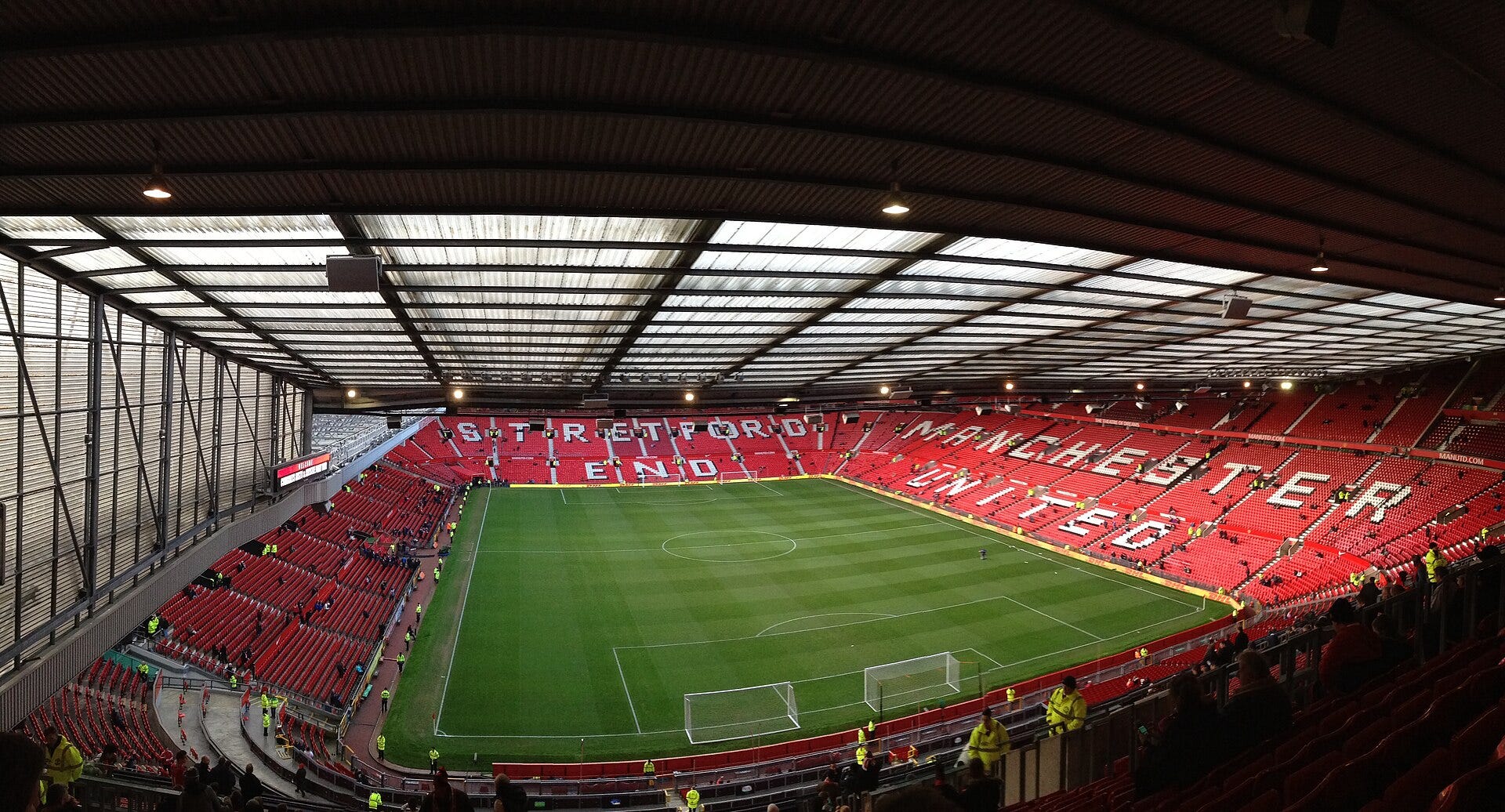
Old Trafford, Manchester. Photo: Stacey MacNaught / CC BY 2.0, via Wikimedia Commons.
I used to write about Manchester United a lot.
Probably too much.
Transfers. Tactics. Players who needed to leave. Players who absolutely had to arrive. The Glazers. Rebuilds. The rebuild after the rebuild. Eventually, I was asking the same questions with different names attached to them.
Then I stepped away from writing about United for a while.
Not intentionally, really. There was just more football I wanted to understand. More stories I wanted to tell. And somewhere along the way, I stopped trying to solve Manchester United every week.
Which might be why I noticed something strange this summer.
I think I can see it.
Not success. Certainly not that. We are two matches into a Premier League season. Declaring anything about Manchester United this early feels dangerous.
But a direction?
Maybe.
United have spent heavily again. They have changed the midfield almost beyond recognition. There are still obvious holes in the squad, some frustratingly obvious. And yet, looking at the players Michael Carrick has been given and the football he appears to want them to play, I keep coming back to the same question.
Can we finally see what Manchester United are trying to build?
Another Rebuild
We’ve been here before.
Every Manchester United manager eventually gets his summer. A few new players arrive, somebody poses with the shirt, and we start drawing formations in our heads before they’ve even found a house in Manchester.
This time, though, the order has been a little different.
Michael Carrick didn’t arrive this summer with a list of demands and a blank check. He arrived in January with somebody else’s team. More specifically, a team largely constructed around Ruben Amorim and a system Carrick almost immediately abandoned.
The back four returned. Bruno Fernandes moved higher. Players began appearing in positions that felt more familiar. United became more compact and considerably more functional.
Then they started winning.
Carrick won 11 of his first 16 Premier League matches as interim manager, losing only twice. United beat Manchester City, Arsenal, Liverpool and Chelsea along the way and eventually secured Champions League football. By May, the interim label was gone.
That matters because United didn’t spend the summer trying to imagine what Carrick’s football might look like.
They had already seen it.
Carrick had taken a squad built for somebody else, changed how it played and gotten results. The summer gave United their first real opportunity to ask a different question: what could this look like with players actually chosen for it?
If there is a coherent plan here, the easiest place to start looking for it is where United spent the money.
Midfield.
Follow the Players
Manchester United spent roughly £150 million rebuilding their midfield this summer.
That sentence, by itself, tells us almost nothing.
United spending money has never been particularly interesting. They’ve been very good at that. What matters is whether the money tells us anything about the team they are trying to become.
So forget the fees for a minute and look at the players.
Youri Tielemans is 29. He isn’t a project. He is an experienced Premier League midfielder comfortable receiving the ball centrally, progressing possession and controlling the tempo of a match. Last season at Aston Villa, he recorded 27 key passes in 1,861 league minutes despite starting only 21 matches.
Andrey Santos is 22 and offers something different. During the 2025/26 season, Santos completed 90.1 percent of his passes while averaging 57.1 passes per 90, and his 67.8 percent ground-duel success rate led Premier League midfielders who played at least 1,000 minutes. There is development ahead of him, but he already offers defensive security without treating possession like something that needs to be gotten rid of as quickly as possible.
Carlos Baleba is 22 as well, but the attraction is much more physical. He can carry the ball, recover it and cover space. When possession breaks down, Baleba gives United the kind of athleticism their midfield has too often lacked.
None of those profiles are especially revolutionary on their own.
Together, they start becoming interesting.
Tielemans can control. Santos can circulate. Baleba can cover.
There is overlap, obviously. There should be. But they aren’t three expensive attempts to solve the same problem. They look complementary.
That becomes more interesting when you look backward at Carrick’s football.
His teams want to build short, create numbers centrally and move players through different spaces as possession develops. That kind of football asks midfielders to receive under pressure, move the ball forward and cover the space left behind when those movements break down.
Suddenly, the shopping list starts making a little more sense.
Maybe United didn’t simply decide they needed better midfielders. Maybe they decided what they needed their midfield to do, then went looking for players capable of doing different parts of it.
That sounds like an incredibly ordinary way to build a football team.
At Manchester United, it feels almost radical.
There is one rather large complication, though.
His name is Kobbie Mainoo.
What About Kobbie?
This is where things get slightly uncomfortable.
Six months ago, Kobbie Mainoo looked like one of the clearest beneficiaries of Michael Carrick taking over Manchester United.
Carrick put him back in central midfield, gave him more freedom and, eventually, Mainoo played his way back into the England picture and onto the World Cup squad.
Then United spent roughly £150 million rebuilding his position.
Mainoo didn’t even start the opening match against Hull.
The easiest conclusion is that Carrick doesn’t see him as part of the long-term plan. I’m not sure the evidence gets us there.
If anything, Carrick’s use of Mainoo last season makes that harder to argue. He trusted him. Mainoo improved. A player who had looked somewhat lost before Carrick arrived suddenly looked comfortable again.
Maybe we’re asking the wrong question.
Perhaps Tielemans, Santos and Baleba weren’t bought to replace Mainoo at all. United aren’t playing a 17-match rescue mission anymore. They have a Premier League season, Champions League football and two domestic cups to navigate. Whatever Carrick ultimately decides his best midfield looks like, he is going to need more than one version of it.
That doesn’t tell us exactly where Mainoo fits.
Two matches into a season probably aren’t supposed to.
But it does change how I look at the spending.
United didn’t spend £150 million to build one midfield. They spent it building a group.
Mainoo’s place within that group is still an open question.
The same cannot be said about the depth everywhere else.
Then There’s the Defense
And this is where my confidence starts to disappear.
For everything that makes sense about Manchester United’s midfield rebuild, there is Luke Shaw standing at left-back with very little behind him.
This wasn’t a surprise.
United had been interested in Lewis Hall since at least March. Newcastle rejected their approach. Other options were considered. By August, another left-back was still being described as a priority.
United knew the position needed attention.
Then they spent roughly £150 million on midfielders.
That doesn’t necessarily make the decision wrong. It does make it a decision.
There is a difference between failing to recognize a weakness and choosing to address another one first. United appear to have done the latter.
The problem is that football doesn’t particularly care about your order of operations.
Shaw has already had uncomfortable moments through the opening matches. Against Ipswich, Abdul Fatawu beat him on United’s left before finding Leif Davis for the opening goal. United have conceded four times through their first two league matches.
Two matches tell us very little. They certainly don’t tell us Luke Shaw is finished, and I’m not particularly interested in pretending they do.
They do remind us what happens when a known weakness remains a known weakness.
And left-back might not even be the whole problem.
Questions remain at centre-back. Matthijs de Ligt’s availability has been a concern. The longer-term picture at both full-back positions is hardly settled. Even before the window opened, there was an argument that Carrick’s defense would eventually need the same kind of attention United have now given the midfield.
And when the window closed, the left-back had never arrived.
Maybe the defense is simply next.
United spent heavily on their attack in 2025 before turning their attention to midfield this summer. There is a version of this rebuild where the defense becomes the next major project.
But that explanation only works if United eventually get there.
For now, Carrick has a midfield that looks increasingly suited to what he wants to do and a defense that still carries some of the same questions it did before the summer began.
Annoyingly, rebuilding a squad piece by piece makes a lot of sense.
There is also risk in deciding which piece gets to wait.
Football supporters, myself very much included, would prefer every problem solved immediately. Preferably by someone exciting, expensive and announced before dinner.
Real squad building doesn’t usually work that way.
The Other Half of Building a Squad
Knowing what you need and actually getting it are two different things.
Joshua Zirkzee may be the best example of that.
By the time the window closed, Zirkzee was still a Manchester United player.
So was the problem at left-back.
United explored options. Zirkzee attracted interest. A late move might have created some of the flexibility needed to address the weakness sitting behind Luke Shaw.
Neither happened.
But moving a player simply because someone wants him isn’t much of a strategy either.
United have spent years buying aggressively and then struggling to recover value when those players no longer fit. Moving Zirkzee on unfavorable terms simply to solve another problem might help today while repeating one of the habits that helped create this squad in the first place.
Keeping him has consequences too. United preserve attacking depth and the value of an asset, but potentially leave Carrick short in a position they already know needs strengthening.
United made their choice. Whether it was the correct one is something else entirely.
That might be the point.
Identifying what a squad needs is relatively easy. Actually getting there means balancing the football, the finances and the players already under contract.
Sometimes a coherent plan still runs into a messy reality.
Can We See It Yet?
I started looking at this summer expecting to find another Manchester United rebuild.
Another collection of talented players. Another enormous transfer bill. Another attempt to convince ourselves that this time, somehow, all the pieces would fit.
I don’t think that’s what I found.
That doesn’t mean United have had a perfect summer. They haven’t. The window closed without the left-back they spent months considering. The defense still worries me. There are players whose roles remain unclear, and two Premier League matches tell us almost nothing about whether any of this will actually work.
But I can see the idea.
Carrick showed United how he wanted to play before they gave him his own players. The club then spent heavily rebuilding the area of the pitch most important to making that football work.
Maybe that’s what feels different.
For so long, Manchester United seemed to buy players and figure out the fit afterward. This summer looks more like they identified what Carrick’s football needed and went looking for players who could provide it.
It feels almost embarrassingly simple when you write it down.
Maybe that says more about Manchester United’s last decade than it does about this summer.
And I’m still reluctant to get too excited.
A plan is not proof.
Coherent recruitment doesn’t guarantee coherent football. £150 million worth of midfielders doesn’t solve the questions at left-back or centre-back. It doesn’t tell us exactly where Kobbie Mainoo fits. And it certainly doesn’t turn September into May.
Carrick still has to make all of this work.
But an incomplete rebuild isn’t necessarily an incoherent one.
That’s where I’ve landed.
For years, I watched Manchester United buy players and wondered how they were eventually supposed to fit together. For the first time in a while, I can look at how they want to play and understand why they bought the players they did.
Can we see it yet?
Yeah.
I think we can.
Now we get to find out if it’s any good.
Research & References
This article draws upon reporting, match records and statistical data from the Premier League, Reuters, Sky Sports, The Guardian, England Football and other contemporary reporting used to examine Manchester United’s summer recruitment and Michael Carrick’s developing squad.
Where appropriate, hyperlinks throughout the article direct readers to the original reporting, match reports and statistical sources used during the research process.
What do you think?
Can you see what Manchester United are trying to build under Michael Carrick?
And if you can, do you think they’ve built enough of it to actually work?
I’d love to hear your perspective in the comments.
Kaleb, this is a great read, I've just had a chance to come back to this. I'm exactly like one of the people you mentioned - I would love for everything to be solved in one transfer window even when I know it's completely illogical of me. However, when it comes to United sometimes all my logic goes completely out the window.
For so long, United have chucked money at flashy names and decided for their price tags they'll just be able to make it work on the pitch even if they weren't exactly best suited for the system the manager was trying to build. It does make total sense to rebuild the squad area by area and like you mentioned, clearly the midfield has been the priority this summer. What's there to say that in January it's not going to be the turn of the defence?
Although the left back issue is still my number one hangover from this window. I just hope that the decision to rebuild the squad piece by piece is going to bring us success in the long term because if I knew that in January we were going to sign a left back it would make the next few months way easier to watch!