

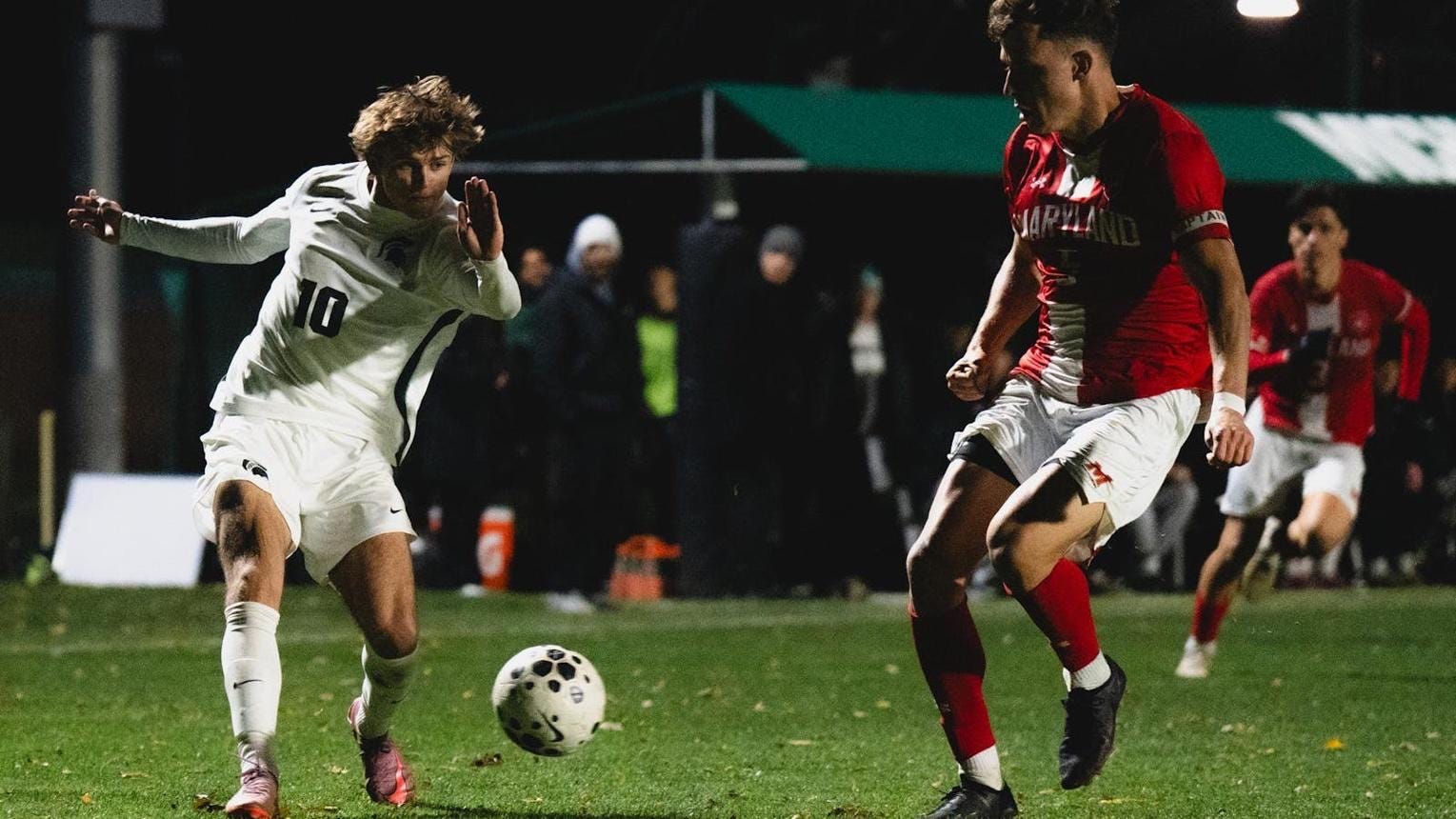
Michigan State vs. Maryland, October 21, 2022. Photo: Joe Andrucyk / Maryland GovPics, CC BY 2.0, via Wikimedia Commons.
On October 7, 2026, the NCAA Division I Cabinet approved a proposal to move men’s college soccer to a two-semester calendar.
Under the proposal, teams would continue operating under the existing annual competition limit, but their matches would be spread across the fall and spring. The national championship would move to the spring as well.
Supporters argued that a longer calendar could reduce fixture congestion, allow more recovery between matches, and limit the amount of class time players missed during the fall.
On November 6, the NCAA’s Division I membership rescinded the proposal.
The decision wasn’t the first sign of disagreement.
Back in June, the Division I Cabinet had returned the proposal for further consideration after the NCAA reported opposition from 20 conferences. Their concerns included the length of the playing season, championship selection, midyear enrollment, and the academic experience of student-athletes.
The proposal returned to the Cabinet in October and received approval. Less than a month later, it was overturned.
What had persuaded the Cabinet that the proposal was workable, and why did enough Division I institutions remain opposed to prevent it from taking effect?
Under the amended legislation, Division I men’s soccer programs would remain limited to 20 contests and up to five scrimmages or exhibitions. Teams could schedule up to 18 contests in the fall and 10 in the spring, but those semester limits did not override the annual maximum.
The five scrimmages or exhibitions could be distributed between the two semesters.
The fall portion would begin in late August and conclude before Thanksgiving. Competition would resume in mid-February, with the national championship moving from December to the spring. The proposal was scheduled to take effect on August 1, 2027.
The legislation also retained the existing 132-day playing-season limit and required five additional days off during the playing season. Those days could be taken at any point rather than being assigned to a particular semester.
Conferences would have flexibility to hold their championships in either semester, while the NCAA’s implementation guidance also addressed eligibility for players enrolling midway through the academic year. A player who had competed for one Division I institution during the fall generally would not be able to transfer and immediately compete for another during the spring portion of the same season.
A related proposal would have moved the transfer notification period to 15 consecutive days following the spring championship, contingent on the calendar change taking effect.
The NCAA’s Men’s Soccer Oversight Committee argued that distributing competition across two semesters could provide more recovery time, reduce weekday travel, and improve the balance between athletics and academics. Supporters also believed it could create a better environment for player development.
The recovery argument raises a question. What do we actually know about fixture congestion and injuries?
A 2022 systematic review examined eight studies involving professional male footballers. Five found a statistically significant increase in match-injury incidence during congested periods, although the findings across different injury measures were not uniform.
Professional footballers operate in different training and recovery environments from college athletes, so those findings cannot simply be transferred to Division I soccer.
Research involving NCAA players provides a more directly relevant perspective.
A 2021 study published in the American Journal of Sports Medicine followed 256 athletes across 12 Division I men’s and women’s soccer teams over one season. Researchers found that noncontact injury incidence was higher when players had only one rest day in the preceding week compared with more than one. The reported incidence rate ratio was 1.58.
The study also examined factors including training-load variation and sleep quality.
The findings give us reason to examine recovery time when considering the college soccer calendar. But the researchers weren’t testing a two-semester season. We still don’t know how much the proposed schedule would have changed recovery between matches, or what that would have meant for injuries.
The NCAA anticipated fewer midweek matches and less missed class time. Distributing competition over a longer period could make that possible, although the public proposal did not establish how much class time individual players would save or whether their overall academic outcomes would improve.
The NCAA also reported broad support for the proposal among men’s soccer student-athletes, while student-athlete representatives on the Division I Cabinet supported the change.
Its public statements did not provide a representative survey, its sample size, or a percentage of all Division I men’s soccer players supporting the proposal. That limits what we can conclude about support across the entire player population.
Florida Gulf Coast athletic director Brian Barrio raised concerns about extending men’s soccer into the spring, when other sports would also need access to facilities and support staff.
The NCAA’s legislative documentation listed the estimated budget impact as varying by institution.
How much would the new calendar actually cost, and which athletic departments would bear those costs?
The publicly available material reviewed for this article doesn’t establish what those costs would look like across Division I.
In June, after opposition from 20 conferences, the Division I Cabinet returned the proposal to the Men’s Soccer Oversight Committee for further consideration.
By October, the committee had provided additional information concerning midyear enrollment and scheduling. According to the NCAA, the Cabinet was generally satisfied that the proposed model could be managed.
The NCAA had also published implementation guidance addressing contest limits, conference championships, and student-athlete eligibility. The public record does not establish whether individual institutions considered those answers sufficient.
The Cabinet approved the legislation, but it did not receive the 75 percent support needed to avoid a membership rescission period.
Under the NCAA’s Division I governance rules, legislation approved with less than 75 percent Cabinet support could be overturned if at least two-thirds of Division I institutions requested rescission within 30 days.
For the men’s soccer proposal, that meant 241 institutions had to actively request that the legislation be rescinded. The process wasn’t restricted to schools sponsoring men’s soccer.
On October 26, Big West commissioner Dan Butterly noted that approximately 215 Division I institutions sponsored the sport. Because the rescission threshold was 241, institutions without men’s soccer programs would have to participate for the effort to succeed.
On November 6, the NCAA confirmed that the necessary threshold had been reached. GOAL reported that 247 institutions requested rescission, including 106 that did not sponsor men's soccer. That would leave 141 requests from institutions sponsoring the sport.
The NCAA confirmed the rescission but did not publish that numerical breakdown in its announcement.
Those figures, if accurate, show opposition among both groups. They don’t establish why individual institutions requested rescission, and participation by schools without men’s soccer programs was permitted under the NCAA’s governance rules.
The Cabinet approved the proposal after reviewing additional information. The membership overturned it less than a month later.
The existing calendar remains in place. The questions about player recovery, academic demands, and the resources required to support a longer season remain unresolved.
Research & References
This article draws on official NCAA Division I governance announcements, the amended legislation proposing a two-semester men’s soccer season, and accompanying implementation guidance. It also incorporates statements from the Big West Conference, original reporting by Front Office Sports and GOAL, and published research examining fixture congestion, recovery time, and injuries in football.
Where possible, I have relied on primary sources, including NCAA legislative records and official governance decisions. Links to the relevant documents, studies, and reporting are included throughout the article.
The injury research requires some distinction. A systematic review published online in 2022 examined eight studies involving professional male footballers, five of which identified statistically significant increases in match-injury incidence during congested periods. The findings were not uniform across all injury measures, and professional football operates under different conditions from NCAA Division I soccer.
A 2021 study published in the American Journal of Sports Medicine followed 256 athletes across 12 Division I men’s and women’s soccer teams. Its reported association between fewer rest days and higher noncontact injury incidence does not establish that adopting a two-semester calendar would reduce injuries. Neither study directly evaluated the proposed NCAA calendar.
The NCAA described broad student-athlete support for the proposal, but its public statements reviewed for this article did not provide a representative survey or a percentage of Division I men’s soccer players supporting the change. Similarly, the publicly available materials reviewed do not establish the financial impact of the proposed calendar across individual athletic departments.
The NCAA confirmed that the membership rescinded the proposal on November 6, 2026. GOAL separately reported that 247 institutions requested rescission, including 106 that did not sponsor men’s soccer. That numerical breakdown is attributed to GOAL rather than presented as an independently verified NCAA tally. The figures do not establish why individual institutions opposed the proposal.
Research and reporting reviewed through November 6, 2026.
What do you think?
The NCAA’s membership has rejected the two-semester calendar, but the questions that prompted the proposal haven’t disappeared. Would you support revisiting the change? What evidence would be required?