

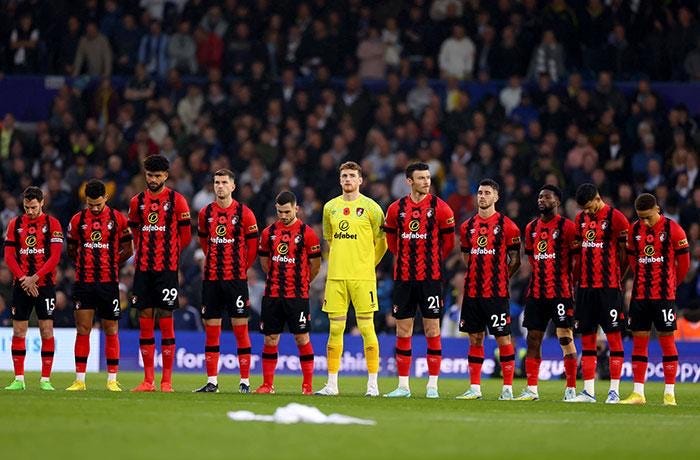
AFC Bournemouth players during the 2025–26 Premier League season. Photograph: Timmy96 / Wikimedia Commons (CC0).
Bournemouth finished sixth in the Premier League in 2025–26, qualifying for European competition for the first time in the club’s history.
Then Marcos Senesi left for Tottenham. Andoni Iraola departed, with Marco Rose replacing him as manager.
New players arrived, but Bournemouth were also losing some of the people who had helped get them there.
By November, they’d won their opening four Europa League matches.
That was an impressive start, particularly considering how much had changed over the summer. But it also raised a question about what Bournemouth had actually managed to build.
European qualification meant eight additional league-phase fixtures, with domestic matches continuing around them. The squad that had earned qualification would now be expected to handle a different schedule.
How much depth could Bournemouth realistically add in one transfer window?
Senesi had played 3,288 Premier League minutes during the qualifying season. Only two Bournemouth players had played more.
Then he left on a free transfer.
Bournemouth signed António Silva from Benfica, bringing in a defender with Champions League experience.
That was a significant addition. But Senesi had already been playing almost every week. Replacing him didn’t necessarily give Bournemouth another option.
Juanlu Sánchez arrived from Sevilla, Álvaro Rodríguez joined from Elche, and Michele Di Gregorio came on loan from Juventus.
Enes Ünal departed, while Álex Jiménez joined Fiorentina on loan after playing 2,317 Premier League minutes during the qualifying season.
Jiménez’s permanent move from Milan had already been agreed during that season. His subsequent loan meant Bournemouth no longer had him available, regardless of the circumstances behind the move.
The arrivals gave Rose more options in several positions. The departures made some of those additions necessary simply to maintain what Bournemouth already had.
And much of the team that earned qualification was still there.
Adrien Truffert played 3,379 Premier League minutes during the qualifying season. Alex Scott played 2,849, and Evanilson 2,742.
All three remained at Bournemouth.
The club had already assembled a squad capable of finishing sixth in the Premier League. It now needed that squad to play more football, while replacing some of the players who had made it successful.
Even the players available domestically weren’t necessarily available in Europe.
Bournemouth’s initial Europa League List A contained 21 players, four fewer than UEFA’s general maximum of 25.
Juanlu Sánchez, Julián Araujo and Max Aarons were among those omitted.
UEFA reserves eight List A places for locally trained players, with no more than four of those places available to association-trained players rather than club-trained players. Clubs unable to meet those requirements have their permitted List A size reduced.
Club-trained status requires a qualifying period of registration during a player’s developmental years. A summer signing doesn’t become club-trained simply by joining Bournemouth.
Eligible younger players can be registered separately on List B, so the 21 names weren’t the entire pool available to Rose.
But a signing that strengthened the Premier League squad didn’t automatically provide another Europa League option.
UEFA allows limited changes to List A in exceptional circumstances, including qualifying long-term injuries. Bournemouth used that provision in September when Ben Gannon-Doak replaced Junior Kroupi.
By November, Juanlu had suffered ankle ligament damage, while Alex Tóth had undergone surgery. Rose also discussed wanting Kroupi back in the European squad when changes became possible.
We don’t know which players Rose would have registered with a full 25 places available, or whether his selections would have changed. What we do know is that Bournemouth couldn’t use every player available to them domestically.
The schedule offered another way to examine what Rose actually had available.
On October 31, Bournemouth played Leeds United in the Premier League.
Five days later, they travelled to Prague to face Sparta Praha in the Europa League.
Three days after that, they faced Ipswich Town.
Rose made eight changes from the Leeds starting eleven for the European match.
Against Ipswich, he restored exactly the same eleven who had started against Leeds.
Three matches in eight days, with most of the starting lineup changed for the European fixture and then changed back.
It was evidence that Rose had alternatives he was willing to use.
But the match in Prague wasn’t entirely straightforward.
Lewis Cook had an opportunity to put Bournemouth ahead from the penalty spot, but his effort struck the post. Ebrima Singhateh then gave Sparta the lead, before Tobias Guddal was sent off shortly before halftime.
Bournemouth entered the break trailing.
Rose brought on Tyler Adams at halftime. Evanilson, Marcus Tavernier and Adrien Truffert followed on the hour, with Rayan introduced later.
Adams, Evanilson and Rayan scored.
Bournemouth won 3–1.
The substitutions helped turn the match around, although Sparta played the entire second half with ten men.
Bournemouth’s rotated starting eleven had created a penalty opportunity before falling behind. The halftime score alone doesn’t establish how well those players performed.
Nor does the comeback establish that the alternatives were as effective as Rose’s regular starters. Several established players were introduced, and the numerical advantage makes it difficult to separate the impact of those substitutions from the circumstances of the match.
Still, Rose had been able to make eight changes and win a European away fixture.
Not everyone had been rested.
James Hill started against Leeds, Sparta and Ipswich. Adam Smith and Ryan Christie also started all three, although both were substituted during the sequence.
Eight changes didn’t mean every position was being rotated.
That doesn’t establish anyone was being overworked. Managers have preferences, players recover differently, and minutes alone can’t tell us whether fatigue is becoming a problem.
It does show that Bournemouth’s rotation wasn’t evenly distributed.
Four wins from four Europa League matches represented an excellent start.
But Bournemouth’s summer recruitment only explains part of what Rose had available.
Some arrivals replaced departures. Others provided alternatives. UEFA registration affected which players could be used in Europe, while much of the squad that had earned qualification remained in place.
Rose had shown he could rotate extensively and still get results, even when the match required contributions from established players.
Whether that approach would hold across an entire European season remained uncertain. Injuries, suspensions and the accumulated schedule could still change what was possible.
Bournemouth had spent the summer preparing for more football, but much of the team Rose was relying on had already been there.
Four European victories showed what that squad could manage in the opening months.
They couldn’t tell us how much of its depth had actually been built during the summer.
Research & References
This article draws on official club announcements, UEFA’s Europa League regulations and match records, and FBref’s Premier League statistics.
The transfer information comes primarily from announcements by the clubs involved, alongside contemporary reporting of Álex Jiménez’s loan to Fiorentina. These records establish who arrived and departed during the summer. They don’t establish whether Bournemouth became stronger, or whether the players arriving offered equivalent replacements for those leaving.
The playing-time figures come from FBref’s 2025–26 Premier League statistics. They cover league minutes rather than all competitions. Those figures help establish how heavily certain players were used during Bournemouth’s qualifying season, but don’t measure their quality or how difficult they would be to replace.
The registration analysis uses Article 31 of UEFA’s 2026–27 Europa League regulations, Bournemouth’s initial squad submission and subsequent registration updates. The original List A contained 21 players, although eligible younger players could be registered separately on List B. UEFA’s locally trained player requirements explain why clubs may have fewer than 25 List A places available. The records establish who could be selected in Europe, but not who Marco Rose would have registered if more places had been available.
The three-match comparison uses Bournemouth’s official team announcements for the Leeds, Sparta Praha and Ipswich fixtures, alongside UEFA’s match records. Those sources establish the eight changes made for the European match, the restoration of the Leeds starting eleven against Ipswich, and the substitutions and match events in Prague.
The comparison covers three matches in eight days. It shows that Rose was willing to rotate extensively and that Bournemouth won the European fixture. It cannot tell us whether the summer’s recruitment made that possible, or whether the same approach would work over a longer period.