

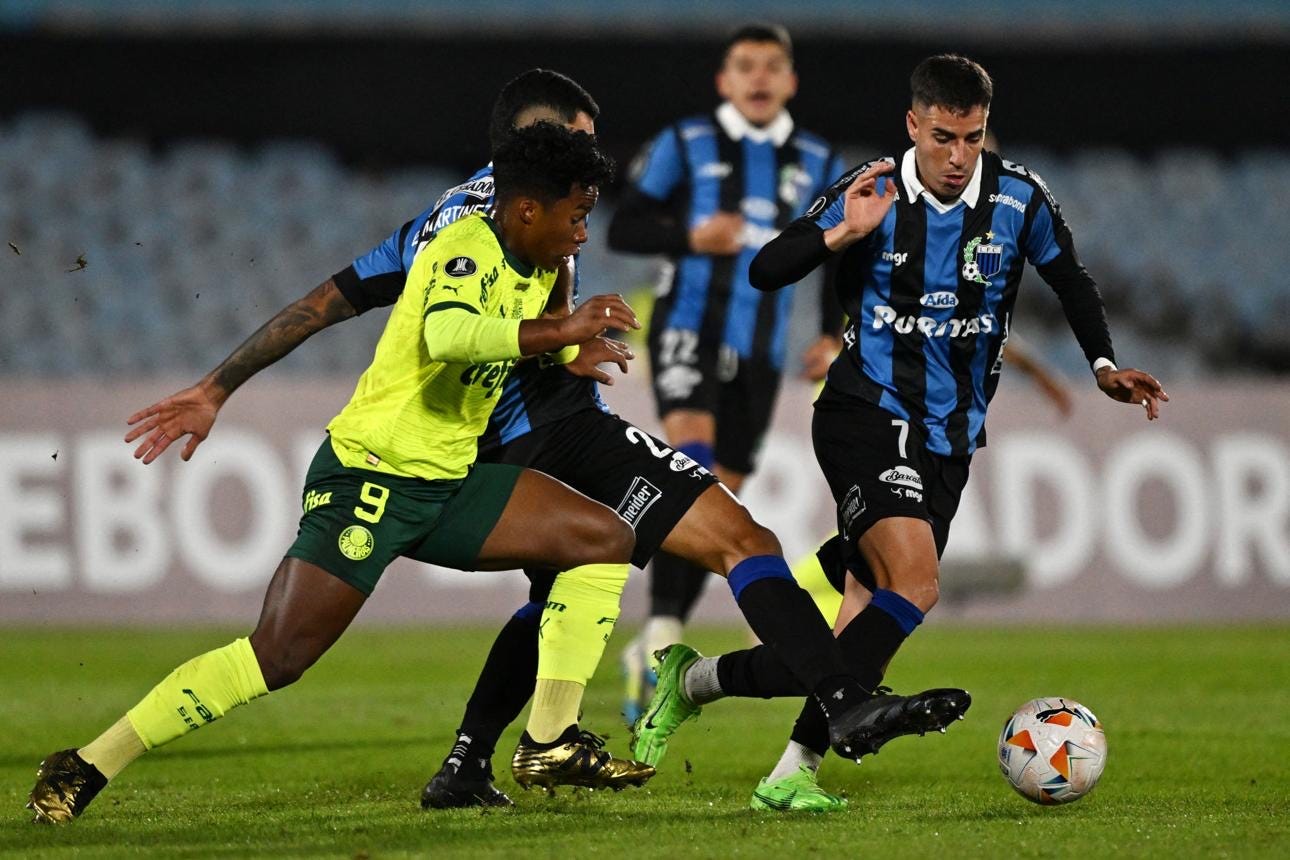
Endrick playing for Palmeiras in April 2024. Photo: Sepguilherme / Wikimedia Commons / CC BY-SA 4.0.
Endrick wants to play football. José Mourinho wants him at Real Madrid. You would think those two things could work together.
So far, they haven’t quite managed it.
Speaking while on international duty with Brazil in November, Endrick described his loan spell at Lyon as one of the happiest periods of his life. He talked about scoring goals, providing assists, and enjoying his football. Asked about another possible move in January, he didn’t rule it out, although he wasn’t rushing toward the exit either.
He also spoke warmly about Mourinho.
Endrick described a manager who checks on him every day, often asking about his personal life rather than football. He appreciates the attention and says it makes him want to give even more to Madrid.
Mourinho has been similarly complimentary. He believes in Endrick’s potential and doesn’t think another loan is necessary.
Yet Endrick has played approximately 140 minutes across seven appearances for Madrid this season.
There doesn’t appear to be much of a personal disagreement. Endrick wants more football, Mourinho wants him available, and both have spoken positively about their relationship.
Which left me wondering what six months at Lyon had actually changed.
Madrid agreed to loan Endrick to Lyon in December 2025, with the arrangement running through June. The difference in playing time was considerable.
During his first season at Madrid, Endrick made 22 La Liga appearances but accumulated only 351 minutes, according to Opta. He featured more prominently in the Copa del Rey, scoring five goals in six appearances. He wasn’t completely without opportunities, but they were unevenly distributed.
At Lyon, he became a regular starter.
He started 14 of his 16 Ligue 1 appearances, scoring five goals and providing seven assists.
The goals initially look encouraging. Five in sixteen appearances isn’t a bad return for a young attacker adjusting to another club.
But three came in a single match against Metz.
That doesn’t make the hat-trick worth any less, although it does change how we should interpret the total. Three of his five league goals came against Metz, leaving two across his other fifteen appearances.
The assists complicate that picture. Seven across sixteen appearances suggests his contributions weren’t limited to finishing chances, even if those numbers alone can’t tell us how much his overall game improved.
Lyon also offered a different environment. The opposition, tactical responsibilities, and competition for places weren’t the same as Madrid. Regular starts gave him opportunities that brief substitute appearances rarely provide.
Still, the loan offered evidence that Endrick could contribute regularly in a major European league.
It didn’t establish where he belonged in Madrid’s attack.
And there was another opportunity to leave.
Roma’s interest in Endrick continued after his return to Spain. Reporting from AS suggested his situation could be reassessed in January. Mourinho, however, made his position clear when asked about another loan.
He wanted Endrick to stay.
There were reasons for that decision. Madrid faced another long season, and keeping a young attacker capable of operating in different positions gave Mourinho another option. It didn’t mean he had promised Endrick a regular starting place.
Then injury complicated the situation.
Mourinho said a muscle problem kept Endrick out for four to five weeks. Even after his recovery, opportunities remained limited. The manager recalled planning to introduce him against Villarreal before the circumstances of the match changed and forced him to reconsider his substitutions.
It’s difficult to judge a player’s opportunities without accounting for when he was actually available. And even when a player is fit, a manager’s plans can change during a match.
Endrick eventually scored against Roma in the Champions League, contributing to Madrid’s comeback victory.
For Mourinho, it was an example of what keeping Endrick available could offer. But a goal from the bench doesn’t establish whether the decision to retain him was preferable to another loan.
Madrid already had established attacking options. Endrick himself acknowledged the difficulty of competing with Kylian Mbappé, while Mourinho’s selections were producing results.
A productive spell at Lyon wasn’t going to remove that competition.
But it did leave an interesting situation.
Mourinho had decided Endrick was worth keeping. Endrick had demonstrated that he could contribute when playing regularly. Yet his opportunities at Madrid remained limited.
Those facts can all be true without anyone necessarily making the wrong decision.
What I find harder to establish is whether the loan was ever likely to change his immediate position at Madrid.
It gave Endrick more senior experience and an opportunity to play regularly. His performances provided evidence of what he could contribute in that environment. But Madrid’s attacking options hadn’t disappeared while he was away, and we don’t know what expectations the club established for his return.
That matters when considering whether the loan was successful.
For Endrick, there are identifiable benefits. He played, contributed, and spoke positively about the experience.
For Madrid, the outcome is less straightforward. They regained a player with additional experience, but we can’t establish whether the loan meaningfully changed how the club evaluated him.
And it certainly didn’t guarantee him a regular place.
So is Endrick falling behind?
His opportunities have been inconsistent, but that doesn’t establish that his development has stalled. We can examine his appearances and attacking contributions. We have far less information about what he’s learning in training or how his abilities are changing.
What Lyon demonstrated was that Endrick could contribute regularly in a different environment. His return to Madrid has shown that those performances weren’t enough, on their own, to secure a consistent role.
He may face another decision in January. Another loan wouldn’t necessarily mean the first one failed, just as remaining at Madrid wouldn’t guarantee more opportunities.
Endrick has a manager who wants him to stay and a recent reminder of what regular football feels like.
Whether Madrid can offer him more of it is still an open question.
Research & References
This piece draws on official Real Madrid announcements and match records, Opta player statistics, Ligue 1 reporting, Endrick’s public comments while on international duty with Brazil, José Mourinho’s statements about the player’s opportunities, and contemporary reporting from AS concerning interest in another loan.
Where possible, I’ve linked directly to official records and original reporting throughout the article. The statistical comparisons use Opta’s competition-specific figures, with Real Madrid’s records providing additional context for Endrick’s appearances and playing time.
The comparisons have some limitations. Endrick’s first season at Madrid, his loan spell at Lyon, and his return to Spain cover different periods, competitions, and circumstances. His 16 Ligue 1 appearances included 14 starts, while his opportunities at Madrid were more frequently limited to substitute appearances. Goals and assists are therefore considered alongside playing time rather than treated as direct measures of improvement.
His five league goals at Lyon also require context. Three came in one match against Metz. That concentration matters when assessing the consistency of his scoring, although his seven league assists provide additional evidence of his attacking contributions.
The reporting about another possible loan requires a separate distinction. Interest from Roma and Mourinho’s publicly stated desire to retain Endrick establish that another move was under discussion. They do not establish the full details of Madrid’s internal decision-making or whether a different arrangement would have been better for his development.
Mourinho’s explanations concerning Endrick’s injury and limited opportunities are attributed to the manager. They provide context for his selections without independently establishing every reason Endrick did or did not play.
The largest limitation concerns development itself. Match appearances, minutes, goals, and assists can help us examine Endrick’s opportunities and contributions. They cannot establish how his technical, tactical, or physical abilities have changed over time.
This investigation does not assume that limited playing time means Endrick’s development has stalled, or that his productive spell at Lyon should automatically have earned him a regular place at Madrid.
The evidence allows us to examine what Endrick accomplished during his loan and what opportunities followed his return. It does not establish whether remaining at Madrid or leaving again would be the better decision for his career.
Sources consulted include official material from Real Madrid and Ligue 1, Opta/The Analyst player statistics, Endrick’s November 2026 interview reporting, Mourinho’s public statements, and original reporting from AS.