

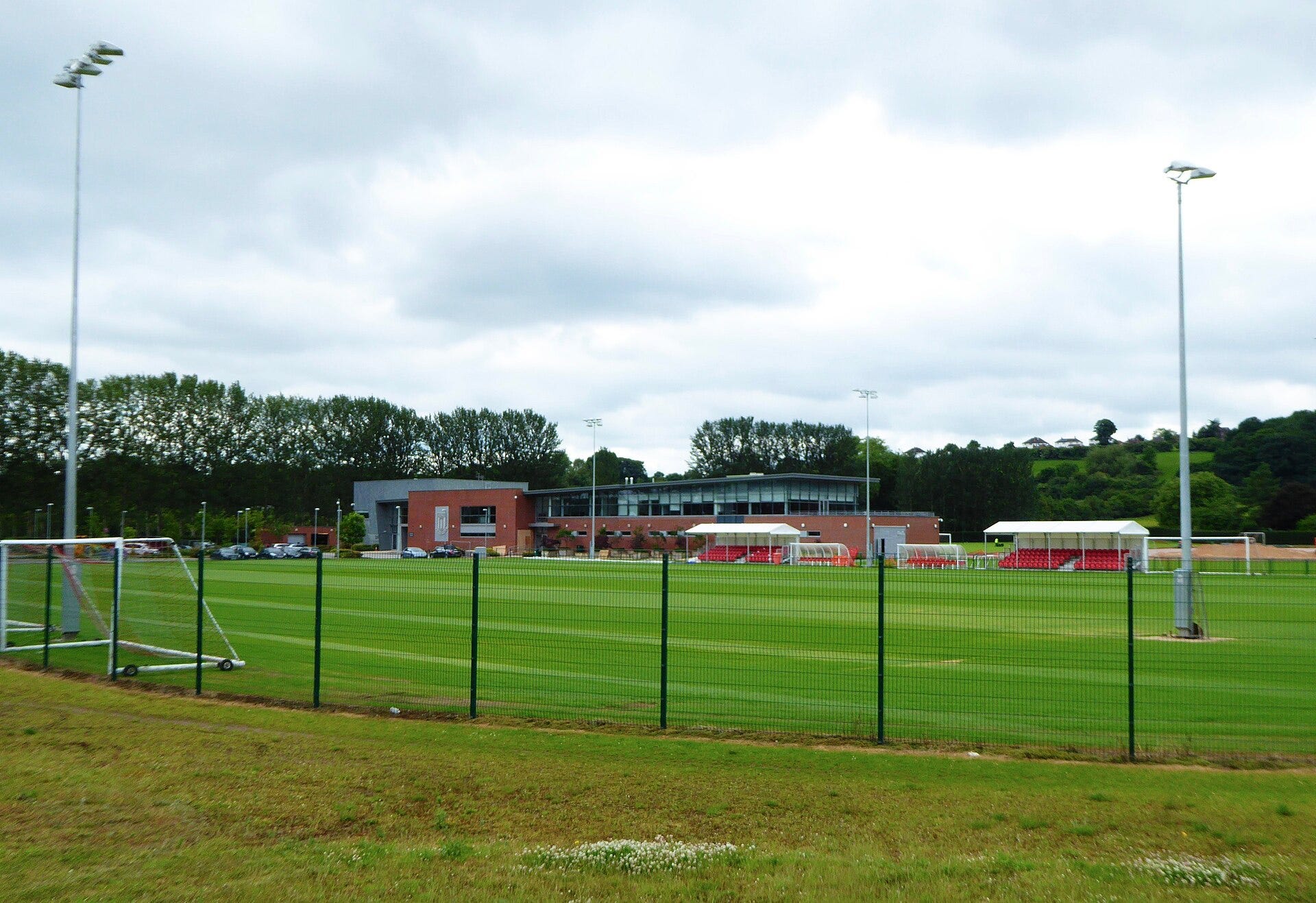
Stoke City Academy and Training Ground, Clayton Wood, Staffordshire, England (2016). Photograph by Jonathan Hutchins / Geograph / Wikimedia Commons. CC BY-SA 2.0
Over the years, I’ve worked with a few students who were involved with, or had attracted interest from, MLS and MLS-affiliated academies here in the United States.
As a teacher, I’ve seen students pursue opportunities that extend well beyond the classroom. Those experiences made me curious about how much responsibility a football academy takes for the person, rather than just the player.
I started looking into how academies approach that responsibility and eventually came across the Premier League’s regulations in England.
For certain players, clubs must provide at least three years of support after their academy registration ends.
English football spends years assessing young players. Clubs examine their performances, technical ability, physical development, and potential, trying to determine who might eventually play professionally. Most won’t.
There are only so many opportunities available, and academies have to make decisions about who progresses.
But release doesn’t necessarily end a player’s involvement in football. Some find opportunities elsewhere. Others pursue education, employment, or something entirely different.
I wanted to understand what that responsibility looks like in practice, how the support reaches former players, and how anyone determines whether it’s working.
The three-year commitment comes from Rule 222 of the Premier League’s 2026/27 Youth Development Rules.
Under those regulations, academies must develop and implement an induction and transition strategy. For players leaving during the Professional Development Phase, that strategy must include support for at least three years after their registration ends.
This doesn’t apply to every child who leaves an academy. The Professional Development Phase generally begins at under-17 level, so younger players aren’t automatically covered by the same three-year requirement.
The commitment itself is mandatory. The accompanying guidance describes how clubs might provide that support, including mental and emotional wellbeing, education and employment advice, opportunities to continue playing, and connections through academy alumni networks.
The guidance also recognizes that a player’s circumstances, age, and time spent at an academy should influence the assistance offered. Three years of support doesn’t necessarily mean three years of identical services for every player.
The Premier League also says academies should prepare young people for opportunities beyond professional football, rather than judging their development solely by whether they become professional players.
Under the Premier League’s regulations, Category One, Two, and Three academies must employ a suitably qualified, full-time member of staff responsible for personal development, life skills, and the club’s induction and transition strategy. Category Four academies must nominate an existing staff member to carry out those responsibilities alongside their other duties.
Maybe I’ve got a future in football after all.
Academies are also independently audited.
The Professional Game Academy Audit Company (PGAAC) assesses clubs in areas including safeguarding, compliance with youth development regulations, and the quality of academy operations.
The assessments cover areas including education and player care, and academies can be required to address deficiencies identified during the process.
In November 2022, Carlisle United announced that its academy had completed an external audit. Induction and transitions were among the areas the club identified as having been assessed.
The regulations also require clubs to establish and follow up on mechanisms for gathering feedback separately from academy players and their parents or guardians.
In 2022, researchers published a study examining the experiences of four former academy players who had completed two-year scholarships between the ages of 16 and 18.
All four described feeling increasingly excluded before their release. One recalled arriving at training and discovering he hadn’t been assigned to a team for a practice activity.
Players also described the difficulty of release meetings. They recalled being called individually into meetings while their teammates waited, and the embarrassment of returning afterward.
All four reported receiving no wellbeing aftercare from their former clubs.
These accounts predate the 2026/27 regulations examined here. They cannot establish whether clubs are meeting the current requirements.
Three of the four players had attended the same academy, and they were describing experiences from years earlier. I couldn’t use those interviews to determine how common those experiences were across English football.
Three participants described their most severe psychological difficulties emerging some time after release. The fourth reported a more positive adjustment, eventually finding enjoyment in football again.
A separate study published in September 2026 examined release from the perspective of academy staff.
Researchers interviewed 18 staff members, including eight coaches and ten support staff, working across professional academies in England and Scotland.
Staff described regular reviews and conversations intended to prepare players for decisions about their futures. Yet some players and families still appeared surprised when release came.
They also described difficulties offering support immediately after the decision. Players could struggle to absorb information about education, trials, or other opportunities while processing the news that they wouldn’t be retained.
The researchers recommended separating the release decision from a later conversation about next steps, suggesting that the follow-up take place around a week afterward.
Maintaining contact presented another challenge. Staff described families who stopped responding after release, leaving them uncertain whether further attempts to help would be welcomed.
The club responsible for ending a player’s academy career may also be the organization expected to help them afterward. Even when the people offering support weren’t involved in the decision, that relationship could affect whether the player wanted to remain in contact.
The researchers suggested that a centralized, independent support system might offer another route to assistance, although their interviews didn’t establish whether such an approach would work better.
In 2024, researchers examined a medical aftercare intervention involving male players aged 18 or older who had been released from a Category One Premier League academy during the 2022/23 season.
The players received their medical records, information about previous injuries and cardiac screening, individualized health recommendations, and contact details for further support.
Of the 15 eligible players invited to participate, 12 completed the study.
All 12 reported being satisfied with the information they received. Nine said it helped them feel better prepared for their next career steps, while ten believed similar information should be provided to other released academy players.
Five participants didn’t know when their next cardiac screening was due. Eleven knew whom to contact at their former club about medical or welfare questions, and nine knew about external mental-health resources.
The responses were positive, but this was one intervention involving twelve players at a single academy. Players who were injured or no longer communicating with the club were excluded, and there was no comparison group.
The research measured participants’ responses to the intervention. It didn’t establish whether their health or career outcomes improved over the following years.
Premier League Futures provides selected current and former academy players with opportunities to explore careers beyond playing. The Professional Footballers’ Association offers independent advice and other assistance to young players.
These are additional routes to support, rather than evidence that every eligible player receives the same assistance.
Three years of support after release is a substantial commitment.
The Premier League has established regulations requiring it, and there is independent oversight of academy operations. Research also provides examples of practical assistance that former players have valued.
But providing support and determining whether that support has helped are different things.
A player might receive help finding another club but decide to pursue education instead. Another might accept support and still struggle to find their next opportunity. Neither outcome alone tells us whether the assistance was appropriate or effective.
The research also raises questions about whose experiences are captured. Players who stop communicating with their former clubs may be difficult to include in assessments, regardless of why that contact ended.
I started looking into this because I wanted to understand what responsibility an academy has to a player once their time there ends.
I found regulations requiring continued support, independent oversight of academy operations, and research showing that some forms of assistance are valued by former players.
What I couldn’t establish from the publicly available material was how the effectiveness of that three-year commitment is measured. Detailed assessments may exist internally, but I couldn’t determine what they measure or what they’ve found.
The Premier League has made a commitment to players whose academy careers have ended. I can see what the regulations require. I still don’t know how well that commitment works for the people it’s supposed to help.
Research & References
This piece draws on the Premier League’s 2026/27 Youth Development Rules, information about academy oversight and player development, and peer-reviewed research examining the experiences of released academy players, academy staff, and medical aftercare.
Where possible, I’ve linked directly to the regulations, original studies, and official announcements throughout the article. These include the Premier League’s requirements for induction and transition support, Carlisle United’s 2022 academy audit announcement, and research published in 2022, 2024, and 2026.
An important distinction runs through the reporting. The Premier League’s regulations establish what clubs are required to provide, but those requirements don’t establish how effectively support reaches former players or whether it improves their circumstances.
The research also has limitations. The 2022 study involved four former players, three of whom attended the same academy. The 2026 study examined the perspectives of eighteen academy staff members rather than measuring outcomes for released players. The 2024 medical aftercare study involved twelve participants at a single academy and did not assess their longer-term outcomes.
Those limitations matter.
The accounts of former players help explain why support after release is important. The staff interviews identify challenges clubs may face in delivering it. The medical intervention offers an example of assistance that participants valued. None of those studies establishes how consistently the Premier League’s three-year aftercare commitment is delivered or how effective it is across the academy system.
This investigation does not assume that clubs are failing to support released players. It also does not treat the existence of regulations, audits, or support programs as proof that the intended outcomes have been achieved.
Sources consulted include official Premier League regulations and academy-development material; Carlisle United’s public audit announcement; research published in Frontiers in Sports and Active Living, the Journal of Applied Sport Psychology, and BMJ Open Sport & Exercise Medicine; and information from the Premier League and Professional Footballers’ Association about additional player support.
What do you think?
When a young player is released from an academy, how much responsibility should that club have for helping them afterward?