

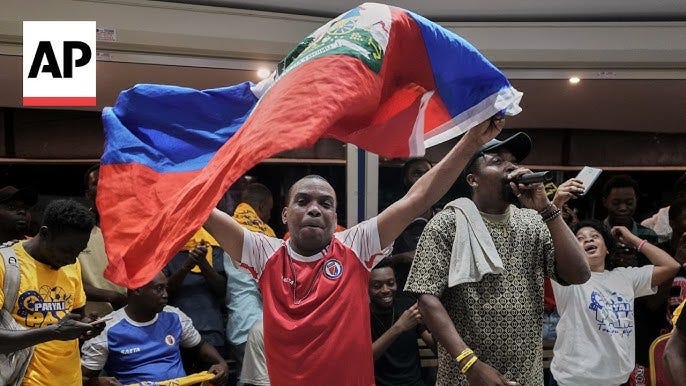
Haitian supporters celebrate during the 2026 World Cup. Photo: Associated Press.
There is a student I taught during the 2021–22 school year that I still think about.
He was my first Haitian student.
At the time, Haiti existed in my mind mostly the way distant countries often do. A place you read about more than understand. A country that appeared in headlines but rarely in conversations.
Then he walked into my classroom.
My grandmother’s first language was French. Hearing pieces of that language again years later in an Indiana classroom felt strangely familiar. Haitian Creole carries its own identity and history, but there was enough familiarity to make me curious.
That curiosity became conversation.
Conversation became relationship.
Since then, I have taught Haitian students nearly every year.
They have taught me far more about Haiti than any article, documentary, or textbook ever could.
Which is why this World Cup has felt different.
When Haiti plays, I do not find myself watching strangers.
I think about students.
I think about families.
I think about conversations that happened years before this tournament ever began.
I think about a country that entered my classroom long before it entered my television.
This Haitian side has spent much of its recent history playing away from home. Political instability and violence have made true home matches increasingly difficult. They entered a group many expected them to struggle through. Larger nations. Larger player pools. Greater resources.
Yet they have never looked intimidated.
They press.
They compete.
They believe.
One of the things that has struck me most during this tournament is how little they seem interested in their assigned role. They do not play like a team grateful to be here. They play like a team that believes it belongs here.
That confidence feels familiar.
Over the years, my students have taught me that community matters deeply. Family matters. Pride matters. Success rarely belongs to one person alone.
Watching this team, I see some of those same qualities.
The players run for one another.
The celebrations belong to everyone.
The shirt means something.
There is a temptation in football to measure success only by results. Points. Tables. Knockout rounds. Trophies.
But some teams teach us something regardless of where they finish.
Haiti has become one of those teams.
In a tournament dominated by transfer valuations, superstars, and endless discussion about who belongs among football’s elite, Haiti has simply insisted on belonging.
Not because anyone granted them permission.
Because they already believed they did.
As teachers, we often think we are the ones giving lessons.
The truth is usually more complicated.
Years ago, my students taught me something about Haiti.
This summer, a football team reminded me.
Football does not always teach us something new.
Sometimes it simply returns us to lessons we had forgotten.