

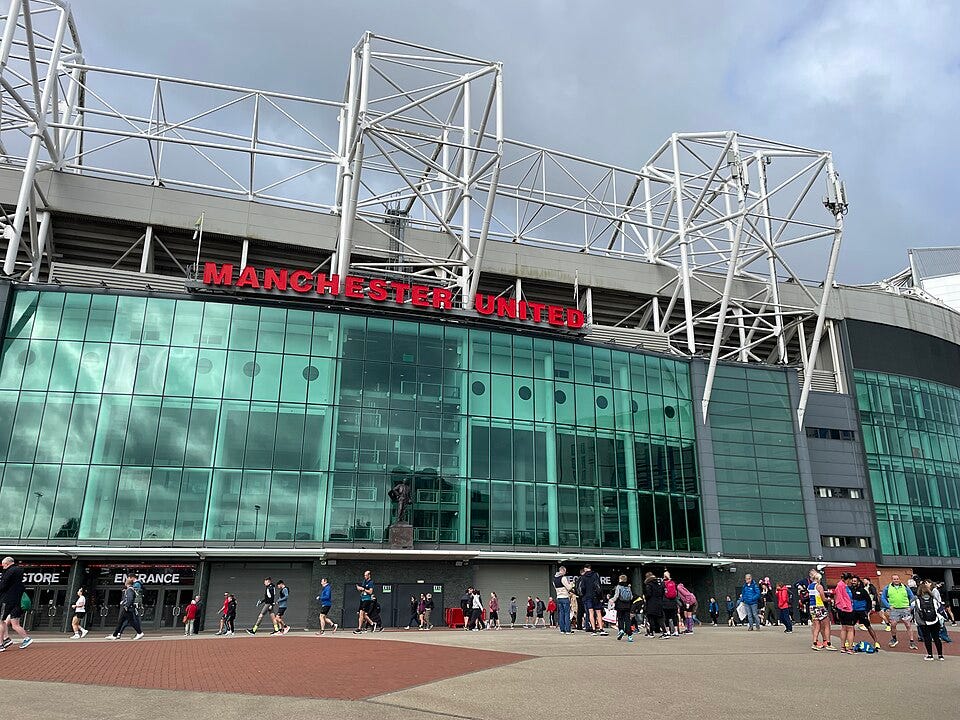
Photo: Eirian Evans / Geograph Britain and Ireland. Licensed under CC BY-SA 2.0. Original photograph.

In October 2025, Sir Jim Ratcliffe was asked about Ruben Amorim’s future at Manchester United.
He said Amorim needed three years to prove himself.
By January, Amorim was gone.
Less than three months separated those moments. United’s results remained inconsistent, questions about Amorim’s approach persisted, and his relationship with the football department had deteriorated.
There were reasons to reconsider his position. But I kept coming back to the three years.
United had already been through something similar with Erik ten Hag.
In June 2024, the club reviewed his position and decided to retain him. In July, it extended his contract. By October, he had been dismissed.
Two managers. Two decisions to back them. Two reversals.
Then, on October 13, 2026, Lisandro Martínez raised a familiar concern.
Following United’s Champions League defeat to Atlético Madrid, the defender publicly questioned the club’s summer recruitment and named director of football Jason Wilcox.
Martínez was speaking after a frustrating defeat. His criticism wasn’t proof that recruitment had failed. But he’d directed attention above the dugout.
United had changed managers, appointed executives, reorganized its football department, and spent heavily on players.
We’d spent months debating what the managers were getting wrong. I wanted to know how United judged the people who’d hired them.
Those decisions weren’t necessarily wrong. Ratcliffe had even acknowledged mistakes made during the rebuilding of United’s football leadership.
But how were we supposed to judge the people making them?
We spend plenty of time evaluating Manchester United’s managers.
What about everyone else?
Erik ten Hag probably couldn’t have picked a better afternoon to complicate his employers’ plans.
On May 25, 2024, Manchester United beat Manchester City 2–1 at Wembley to win the FA Cup. It was Ten Hag’s second trophy in two seasons, arriving days after United had finished eighth in the Premier League. Their lowest finish of the Premier League era.
United had beaten the champions in a cup final after spending much of the season struggling against considerably less formidable opposition.
By then, Sir Jim Ratcliffe’s INEOS group had assumed responsibility for United’s football operations. Ten Hag’s future was under review, and Wembley had given the new leadership something else to consider.
There were arguments for keeping him. Injuries had disrupted the season, younger players had developed, and the FA Cup offered evidence that the team could still respond to his coaching. United were also rebuilding their football department. Replacing Ten Hag wouldn’t necessarily resolve problems elsewhere in the club.
On June 11, United decided to retain him. On July 4, it extended his contract through June 2026.
According to Jamie Jackson in The Guardian, Ten Hag’s willingness to accept tactical input from Jason Wilcox had impressed Ratcliffe and Dave Brailsford. Wilcox had reportedly suggested using Bruno Fernandes as a false nine against City in the cup final.
United were appointing executives to oversee football decisions beyond the manager. A coach willing to work within that structure might have been worth keeping.
We don’t know how heavily that collaboration influenced the review.
United’s July announcement also included an endorsement from Dan Ashworth, who had formally started as sporting director that month. He hadn’t been in post for the June decision, but was publicly supporting it by July.
By October 28, Ten Hag was gone.
Nine Premier League matches into the new season, United had won three, drawn two, and lost four. They were 14th.
Those results gave the club grounds to reconsider. United had finished eighth the previous season, and the problems hadn’t disappeared.
But the leadership had known about those problems in June.
I don’t think changing its mind was necessarily the mistake. Nine more matches provided new evidence, and a club should be willing to act on it.
What I wanted to know was what United had expected when it decided to keep him.
What had changed by October to make the plan approved in June no longer worth pursuing?
United’s next appointment would raise a similar question, under rather different circumstances.
When Manchester United announced Ruben Amorim as their new head coach on November 1, 2024, there wasn’t much mystery about how he liked his teams to play.
At Sporting CP, Amorim had won two Portuguese league titles and established a recognizable approach built around a back three, most often arranged in a 3-4-3.
United knew what they were getting. At least on the pitch.
There was an immediate complication. Much of United’s squad had been recruited under previous managers, whose tactical preferences differed from Amorim’s. Players accustomed to a back four were being asked to learn different responsibilities.
Amorim chose to introduce his system immediately. I can understand why. United had hired a coach whose success was closely associated with that approach. Asking him to abandon it before he’d had a chance to establish it would have been a strange start.
But there were reportedly concerns about the fit.
According to Rob Draper’s later reporting in The Guardian, sporting director Dan Ashworth had raised reservations about whether Amorim’s preferred system suited United’s existing squad. Draper reported that Ashworth favored a safer appointment and warned that United lacked the players for a 3-4-3.
United maintained that everyone had supported the appointment once it was made. We don’t know precisely how Ashworth’s earlier concerns were discussed or addressed.
Amorim’s first, partial season ended with United finishing 15th in the Premier League. The following summer, the club invested heavily in its attack, signing Matheus Cunha, Bryan Mbeumo, and Benjamin Šeško.
By January 2026, United were sixth. An improvement, certainly, but performances remained inconsistent.
On December 24, Amorim acknowledged that building a team for his preferred 3-4-3 would require considerable time and money. He also accepted that he might need to adapt.
Two days later, United beat Newcastle 1–0.
Amorim had changed to a back four. Patrick Dorgu played further forward and scored the winner.
Against Wolves on December 30, United drew 1–1. Contemporary match reports described a return toward Amorim’s familiar three-defender approach, although published formation graphics differed.
Subsequent reporting described Wilcox questioning Amorim’s tactical choices, including his willingness to persist with the system he had brought from Sporting.
One win and one draw, against different opponents, hardly settle an argument about formations. But Amorim had demonstrated that he could change his approach. The disagreement appeared to concern how often he should do so.
Reporting from BBC Sport, Sky Sports, and The Guardian described growing tension over tactical flexibility, recruitment, and the division of responsibilities between Amorim and the football department. Some accounts suggested United’s leadership believed he’d agreed to adapt his approach, although the precise understanding between the two sides remains unclear.
Following United’s 1–1 draw at Leeds on January 4, Amorim insisted that he’d come to United to be the manager, not merely the coach. He challenged others within the organization to fulfill their responsibilities.
A remarkable distinction from someone officially appointed as head coach.
The following day, United dismissed him.
The club’s statement acknowledged that United were sixth and said the change was intended to give the team the best possible chance of finishing as high as possible. It did not identify a dispute with Wilcox as the reason.
There was a sporting argument for dismissal. Amorim’s overall league record had been poor, and the improvement in position hadn’t resolved concerns about performances.
But United had appointed him knowing his preferred system. There had reportedly been reservations about its compatibility with the squad, and the club had publicly backed him for the longer term.
How much of Amorim’s approach was United prepared to accommodate, and how much was he expected to change?
His successor would inherit many of the same players.
And he was about to do something rather different with them.
Michael Carrick’s first advantage was that he didn’t have to wait for a transfer window.
When he took charge in January 2026, he inherited much of the squad Ruben Amorim had been working with. He began by changing how they played.
United returned to a back four. Bruno Fernandes operated in more advanced areas, and Patrick Dorgu was used further forward rather than primarily as a wing-back.
Dorgu was particularly interesting.
Under Amorim, he’d scored the winner against Newcastle in December after United changed their shape. Carrick continued using him further forward, and Dorgu scored against Manchester City and Arsenal in his new manager’s first two Premier League matches.
Three goals across three matches, under two different coaches.
It would be tempting to conclude that Amorim had been using him incorrectly.
Except Amorim had already tried something similar.
Carrick hadn’t discovered an attacking player nobody else knew existed. He’d continued using a player whose versatility was already apparent.
And Dorgu wasn’t the only one.
Matheus Cunha and Bryan Mbeumo had arrived in the summer of 2025 with experience across multiple attacking positions. Benjamin Šeško offered another option through the middle.
All three had been recruited while Amorim was head coach, yet they could contribute after United moved away from his 3-4-3.
Mbeumo scored against City and Arsenal during Carrick’s opening two league matches. Cunha supplied the cross for Dorgu’s goal against City and scored the winner at Arsenal. Šeško also began scoring more regularly.
We can’t establish how much of that flexibility was deliberate recruitment planning. But United had changed managers without immediately needing to replace the attacking players signed during his predecessor’s tenure.
The results strengthened Carrick’s case.
Across his first 16 Premier League matches as interim head coach, United won 11, drew three, and lost twice.
Thirty-six points from 16 matches. An average of 2.25 per game.
By May 22, United had secured Champions League qualification and a guaranteed third-place finish, with one league match still to play.
Sixteen matches weren’t a full season, and the improvement couldn’t be attributed solely to a change of formation. But Carrick had produced results with the players available.
According to BBC Sport’s reporting, Jason Wilcox played a leading role in the process of selecting United’s permanent head coach, with Omar Berrada and Ratcliffe also involved.
On May 22, United appointed Carrick permanently, with a contract through 2028.
Carrick had already worked with the squad he would be expected to manage. United had seen his approach in competitive matches and could evaluate his results.
The football department had also assembled players who could contribute under more than one coach. Whether that was deliberate planning or simply useful recruitment remained difficult to establish.
By the time Manchester United appointed Michael Carrick permanently, the football department responsible for selecting managers looked considerably different from the one that had reviewed Erik ten Hag two years earlier.
Some of that change was intentional. Some of it came rather sooner than planned.
Omar Berrada began work as chief executive in July 2024. Dan Ashworth arrived as sporting director that same month, while Jason Wilcox had joined as technical director in April.
By December, Ashworth was gone.
Five months.
United had spent considerable time assembling a leadership team intended to provide stability beyond the manager. Its sporting director had barely settled into the role before departing.
The club described the separation as mutual. Reporting subsequently raised questions about disagreements within the football leadership, including the Amorim appointment. Other accounts, citing club sources, denied that a disagreement over Ten Hag’s replacement caused the departure.
Ratcliffe later described the problem as one of chemistry. He declined to explain the details.
Wilcox became director of football in June 2025, taking on broader responsibility for the sporting operation. Berrada remained chief executive, while Dave Brailsford’s involvement in day-to-day football matters reportedly became less prominent.
Ratcliffe and INEOS continued to exercise considerable influence over football operations, although the Glazer family retained majority voting control of Manchester United plc.
When Ten Hag’s position was reviewed in June 2024, Berrada and Ashworth hadn’t formally begun their roles. By November, both were in place when United appointed Amorim. And by May 2026, Wilcox was director of football as the club considered Carrick’s permanent appointment.
Three decisions, made under a football structure that was still changing.
In March 2025, Ratcliffe publicly accepted that retaining Ten Hag and appointing Ashworth had been mistakes. He apologized and explained that United’s newly assembled leadership had struggled to separate Ten Hag’s performance from the circumstances around him.
Ratcliffe had acknowledged the mistakes. He’d explained why they happened and said United had learned from them.
I wanted to know what that learning looked like.
The summer of 2026 brought further scrutiny. United strengthened their midfield following Casemiro’s departure, and Carrick spoke publicly about recruitment priorities and financial constraints.
After the Champions League defeat to Atlético Madrid in October, Martínez questioned the summer business and named Wilcox among those responsible for football decisions.
His criticism wasn’t an independent assessment of United’s recruitment. But subsequent reporting suggested the frustration extended beyond Martínez. According to Jamie Jackson in The Guardian, other players also questioned the squad’s depth and the decision to concentrate summer spending on midfielders.
There was a complication. Martínez was approaching the end of his contract, and the same reporting suggested his comments were also being interpreted as an attempt to secure a move.
That didn’t make his criticism wrong. It did make his motivations harder to establish.
United had reasons to retain Ten Hag, appoint Amorim, and promote Carrick. The circumstances were different, as were the executives involved.
What remains harder to establish is how the football department evaluated the risks behind those decisions, and whether its approach changed when they went wrong.
I began with the suspicion that Manchester United kept changing managers while the people making those appointments escaped the same scrutiny.
That was too simple.
People above the manager had left. Responsibilities had changed. Ratcliffe had publicly accepted responsibility for mistakes and said the club had learned from them.
What I couldn’t establish was how United evaluated those decisions internally, or whether its process had improved.
And there were reasonable sporting arguments for dismissing both Ten Hag and Amorim.
Carrick complicated things further.
United had appointed him after he improved results with much of the squad he inherited. Players recruited under Amorim had contributed to that improvement. Whatever problems existed within the football department, it hadn’t assembled a group of players who became useless the moment their manager left.
I hadn’t expected that to be quite so important to the story.
But it didn’t settle the questions surrounding the decisions themselves.
We don’t have access to United’s internal assessments. What we can examine are the commitments it made publicly, the decisions that followed, and the risks that were already apparent.
We’ve spent plenty of time asking whether Ten Hag deserved to be sacked, whether Amorim should have adapted sooner, or whether Carrick was the right man for the job.
Those questions matter.
But the managers weren’t the only people making decisions.
And if United expects its coaches to deliver against standards established by the football department, it’s reasonable to ask how that department determines whether those standards were right in the first place.
Research & References
This piece draws on official statements and announcements from Manchester United, Premier League match records, public interviews with Sir Jim Ratcliffe and Ruben Amorim, and contemporary reporting on the club’s managerial appointments, recruitment decisions, and football leadership.
Where possible, I’ve linked directly to the original reporting or primary sources throughout the article. These include Manchester United’s announcements concerning Erik ten Hag, Ruben Amorim, and Michael Carrick; Ratcliffe’s public explanations of the club’s decision-making; and reporting from BBC Sport, Reuters, Sky Sports, and The Guardian.
An important distinction runs through the reporting. Official announcements establish what Manchester United decided and what the club publicly communicated. They do not necessarily explain every consideration behind those decisions. Accounts of internal disagreements, tactical expectations, and recruitment priorities often depend on reporting from people familiar with discussions that were not public.
Those accounts are attributed accordingly. Where reporting conflicts, particularly concerning Dan Ashworth’s departure and the circumstances surrounding Amorim’s appointment, the competing explanations are acknowledged rather than treated as settled findings.
The statistical comparisons also have limits. Carrick’s initial results provide evidence of improvement, but 16 Premier League matches cannot establish that a tactical change alone caused it. Likewise, the contributions of players recruited under Amorim demonstrate their usefulness under another coach without establishing how deliberately that flexibility was planned.
The October 2026 reporting concerning Lisandro Martínez presents a similar distinction. His public criticism of recruitment is documented, while accounts of broader dressing-room dissatisfaction and interpretations of his possible transfer motivations remain attributed reporting. Neither establishes the private intentions of everyone involved.
Those limitations matter.
This investigation does not assume that dismissing a manager was necessarily the wrong decision, that reported disagreements prove institutional dysfunction, or that improved results under a successor establish failures by his predecessor.
The evidence allows us to examine United’s public commitments, the decisions that followed, the people responsible, and the risks that were already apparent. It does not provide access to the club’s internal evaluations or establish whether its decision-making process has improved.
Sources consulted include official material from Manchester United and the Premier League; interviews and reporting published by BBC Sport; original reporting from The Guardian, Reuters, and Sky Sports; and contemporary match coverage.
What do you think?
When Manchester United appoints a manager, how much responsibility should the football department carry for what happens next?
Is changing course evidence that the club has recognized a mistake, or should we expect a clearer explanation of why the original decision was made?
And after Ten Hag, Amorim, and now Carrick, what would actually convince you that United’s decision-making has improved?