

Photograph: Samson Ssemakadde / Wikimedia Commons, CC0 1.0
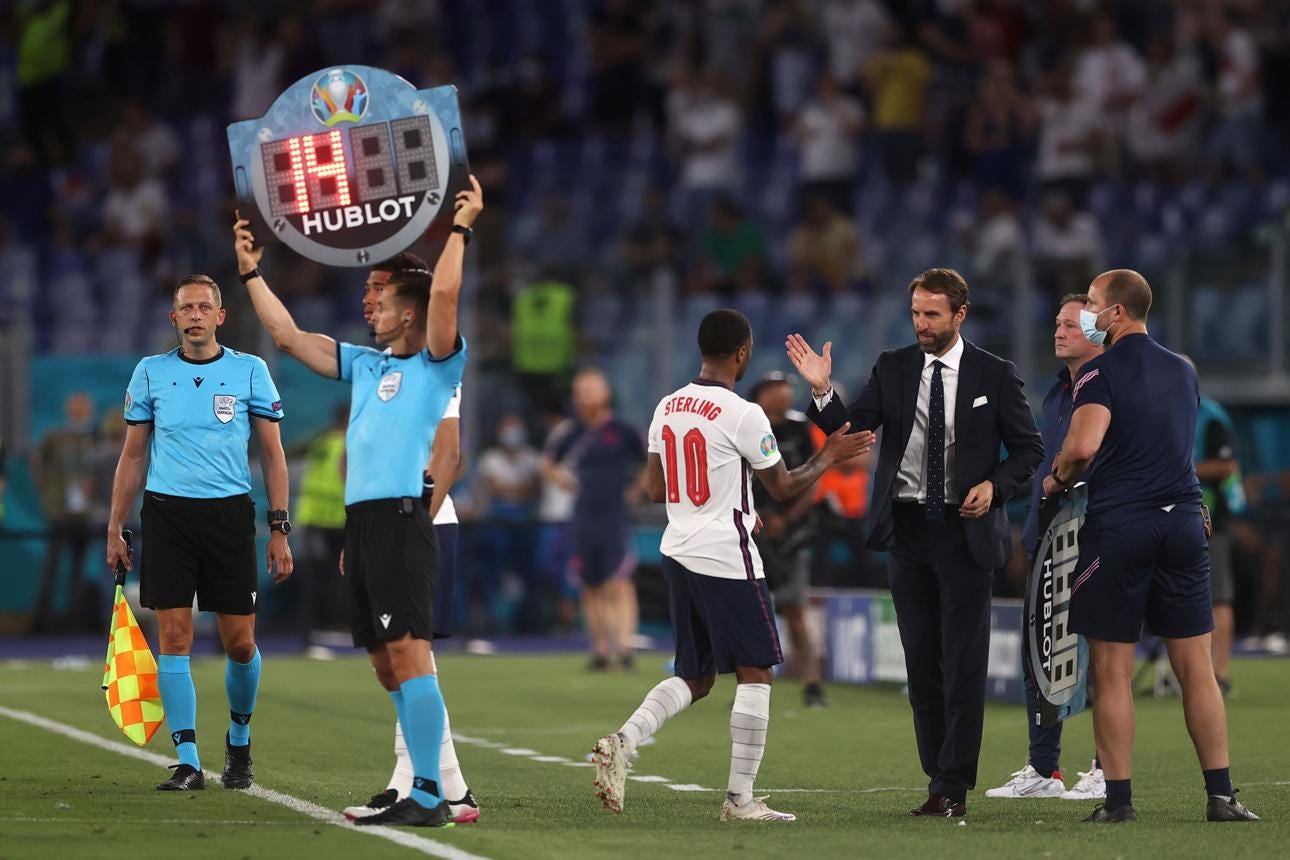
There comes a point in a football match when I find myself watching the clock almost as much as the ball.
Usually, it’s somewhere around the 60th minute. The team is struggling to create anything meaningful, the opposition seems comfortable, and there are players sitting on the bench who might offer something different.
I find myself scrolling back to the colorful, often ridiculously over-the-top matchday graphic to remind myself who’s on the bench. Who could actually help here? Who makes sense given what’s happening on the pitch?
So you wait.
Another five minutes pass. Then another. The manager is still standing on the touchline, and the same problems are playing out in front of him.
Why hasn’t he changed anything?
It’s a familiar frustration. We can see the match slipping away, or at least it feels that way, and a substitution seems like the most obvious response. Fresh legs, a different shape, someone capable of changing the rhythm.
But I’ve started wondering how much of that frustration is actually justified.
Is there something meaningful about the 60th minute? Is waiting until the 75th or 80th genuinely costing a team opportunities? Or have we become so accustomed to expecting substitutions around the hour mark that anything later feels like a mistake?
I wanted to know whether the evidence could tell the difference.
A study of all 51 matches at Euro 2024 examined 466 individual player substitutions and identified three particularly common windows for changes: the 61st through 65th minutes, the 71st through 75th, and the 81st through 85th.
So the pattern is real, at least within that tournament. Managers frequently make changes around the same periods supporters have come to anticipate them.
The researchers also identified the period between the 60th and 85th minutes as particularly effective. Their analysis considered goals scored after substitutions, which team scored them, and the final match result. That makes the finding interesting, although a goal following a substitution doesn’t necessarily mean the change caused it.
When I started looking into whether changes should happen earlier, the research became less straightforward.
In 2012, researcher Bret Myers examined substitution timing for teams trailing in football matches. His findings suggested a surprisingly specific approach: make the first substitution before the 58th minute, the second before the 73rd, and the third before the 79th.
Teams following those guidelines were more likely to improve their goal difference in his analysis.
That sounds like a fairly compelling argument against waiting. If you’re losing, why leave fresh players sitting on the bench while the clock runs down?
But the findings were subsequently challenged.
In 2016, Rajitha Silva and Tim Swartz revisited Myers’s substitution guidelines using a different statistical approach that accounted for differences in team strength. They found no discernible point in the second half when making a substitution offered a clear advantage.
The researchers used different methods to examine substitution effectiveness, and their work came from an era when teams were generally limited to three substitutions. Both are worth considering when applying their findings to today’s five-substitute system.
Another study offered evidence of a relationship between substitutions and a team’s chances of scoring.
In 2021, researchers examined 2,025 Champions League and Europa League matches and found increased scoring probabilities following teams’ first and second substitutions. The association was substantially larger when the team making the change was losing.
That matters because a manager chasing a goal is working against two problems at once. Whatever isn’t functioning on the pitch still needs fixing, but there’s also progressively less time available for any solution to work.
The research can’t tell us whether a particular substitution caused a goal or whether an earlier change would have produced a different result. Teams making substitutions while trailing may also be taking more risks, changing their approach in ways that affect their attacking prospects independently of the players introduced.
And a substitution isn’t always an attempt to score. Managers replace injured players, protect leads, manage fatigue, or change the way their team defends. Two substitutions made in the same minute can serve completely different purposes.
With 25 minutes remaining against Slovakia in the round of 16 at Euro 2024, England were heading out of the tournament.
They had trailed since Ivan Schranz scored in the 25th minute. Phil Foden had an equalizer ruled out for offside shortly after halftime, but England were still struggling to turn possession into meaningful opportunities.
England had 13 attempts during regulation time, but only one was on target, according to UEFA. That doesn’t mean they created nothing. Kane headed wide late in the second half, and Rice struck the post. But for a team facing elimination, there was plenty of reason to question whether the existing approach was producing enough.
Gareth Southgate made his first substitution in the 66th minute, replacing the injured Kieran Trippier with Cole Palmer. Bukayo Saka moved to left-back, and Palmer took up a position on the right.
It was a change, and one that altered England’s positioning, but they were still chasing the same goal.
Southgate waited until the 84th minute to introduce Eberechi Eze for Kobbie Mainoo. Ivan Toney didn’t arrive until deep into stoppage time.
By then, England were seconds away from elimination.
And then Jude Bellingham scored an overhead kick.
Harry Kane headed England into the lead shortly after extra time began, with Toney providing the final pass. England survived, and Southgate’s decisions suddenly had a very different result attached to them.
But did that make the decisions better?
After the match, Southgate acknowledged that he had considered replacing Bellingham with around 15 minutes remaining. The midfielder appeared exhausted, but Southgate knew he was capable of producing something decisive.
That was the calculation. Keep a tired player with an extraordinary ability to influence a match, or introduce someone fresher who might offer more consistent involvement.
Bellingham’s equalizer demonstrated what England stood to lose by removing him. It couldn’t establish what England might have gained by making a different change.
And Southgate had alternatives. Anthony Gordon, Ollie Watkins and Jarrod Bowen remained unused. Trent Alexander-Arnold was also available, offering another way to alter England’s attacking approach.
There’s an important distinction here. Southgate didn’t necessarily have to choose between keeping Bellingham on the pitch and introducing fresh attacking players elsewhere.
He could have done both.
There was also a question of balance. England already had attacking players on the pitch, and introducing another forward wouldn’t necessarily have improved their chances. That’s a reasonable concern, particularly if the problem lay in getting the ball to them.
But retaining Bellingham didn’t require leaving every other player on the pitch. England still had Gordon, Watkins, Bowen and Alexander-Arnold available. Whether one of them could have offered something different remains a fair question.
England’s eventual victory doesn’t establish that Southgate was right to wait.
Two years earlier, Didier Deschamps faced a different version of the same problem.
France were trailing Argentina 2–0 in the 2022 World Cup final. They had struggled to contain Argentina’s movement, and their attack had offered little in response.
Deschamps didn’t wait for halftime.
In the 41st minute, he removed Olivier Giroud and Ousmane Dembélé, introducing Marcus Thuram and Randal Kolo Muani.
It was a remarkably early intervention, particularly for a World Cup final.
But France didn’t suddenly take control.
Argentina remained ahead for another 39 minutes. Deschamps made two further changes in the 71st minute, introducing Kingsley Coman and Eduardo Camavinga.
It wasn’t until Kolo Muani won a penalty in the 80th minute that Kylian Mbappé began France’s comeback. Mbappé equalized a minute later, and France eventually forced extra time before losing on penalties.
One of Deschamps’ early substitutes eventually played a direct role in the recovery. But France had also made further changes, and the match had developed considerably since the 41st minute. We can’t isolate how much of the comeback resulted from that first intervention, or whether waiting until halftime would have changed anything.
Southgate waited and England survived. Deschamps acted early, France recovered, and still lost. Neither result tells us whether the manager chose the best moment to intervene.
The research offers a little more guidance. There is evidence linking substitutions with improved scoring prospects, particularly for teams that are trailing. There is considerably less agreement about exactly when those changes should happen.
That doesn’t make the frustration of watching a manager wait unreasonable.
If a team is struggling to create chances, there are alternatives on the bench, and the manager continues with the same approach, there’s a legitimate question about whether he’s giving those alternatives enough time to make a difference.
But the criticism needs to go further than the clock.
What isn’t working? Who could realistically improve it? And what does the manager risk losing by making the change?
Southgate’s decision to retain Bellingham illustrates the difficulty. His decision to leave other attacking options unused raises a separate question. England’s victory doesn’t automatically settle either one.
I’ll probably still find myself looking toward the bench around the 60th minute.
I just have a better idea of what I’m looking for.
Research & References
This article draws on four academic studies examining football substitution timing and effectiveness, alongside official match records and contemporary comments from Gareth Southgate.
Gabryś and colleagues (2025) examined 466 substitutions across all 51 matches at UEFA Euro 2024. Their analysis identified common substitution windows and investigated relationships between substitution timing, subsequent goals, and match outcomes. The study reported its highest substitution effectiveness rates between the 60th and 85th minutes. These findings describe associations within the tournament and do not establish that making a substitution during that period causes a better result.
Bret Myers (2012) proposed substitution timing guidelines for teams trailing in matches, recommending changes before the 58th, 73rd, and 79th minutes. His analysis associated following those guidelines with a greater likelihood of improving goal difference.
Rajitha Silva and Tim Swartz (2016) subsequently examined Myers’s proposed guidelines using a different statistical approach. Their findings did not identify a particular second-half substitution time that offered a discernible advantage. Both studies examined football during the three-substitution era, limiting their direct applicability to the modern five-substitute system.
Amez and colleagues (2021) analyzed 2,025 UEFA Champions League and Europa League matches. Their research identified increased goal-scoring probabilities following teams’ first and second substitutions, with larger associations when teams were trailing. The findings do not demonstrate that a particular substitution caused a subsequent goal.
The England–Slovakia case study draws on UEFA’s official Euro 2024 match records and England Football’s reporting of Southgate’s post-match comments. The regulation-time shooting figures were calculated by subtracting UEFA’s extra-time figures from its full-match totals. Southgate’s explanation for retaining Jude Bellingham is attributed to his comments following the match.
The Argentina–France comparison uses FIFA’s official account of the 2022 World Cup final and the French Football Federation’s match record to establish the substitution sequence and match chronology.
Neither match establishes what would have happened had the managers made different decisions. The examples illustrate the difficulties of evaluating substitution timing through the eventual result alone.
I liked this beforehand so I remembered to come back and read it fully when I had time as I was super intrigued by the whole concept of this article!
Talking about Euro 2024 reminds me of the jeopardy of that England Slovakia match, screaming at the TV for the players to do something whilst the clock literally and figuratively ticked down. Although the decision to keep Bellingham on the pitch was ultimately the right one, logic went out the window for me pretty fast when it looked like we were heading out.
The fact research has actually been done on the best window to make substitutions is really interesting as they do seem to happen around the same time a lot. Given how data focused everything seems to be these days makes me wonder if clubs pay attention to the findings of these studies as well or just act on pure situational instinct whether to stick or twist.