

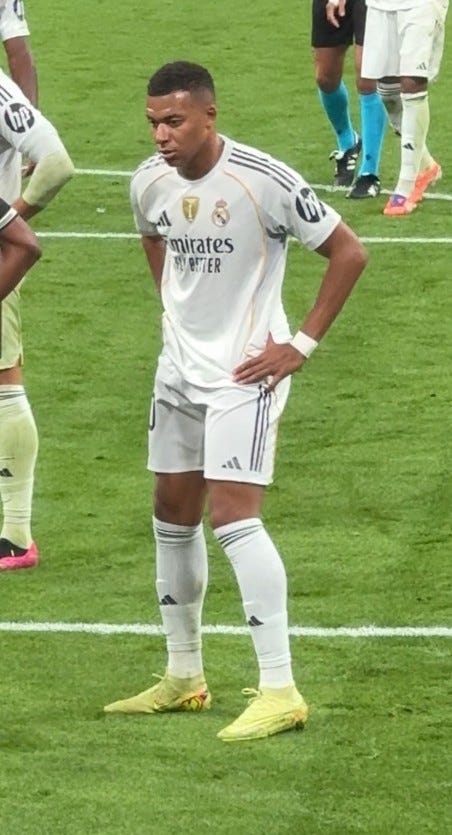
Photo: SdHb / Wikimedia Commons / CC BY-SA 4.0.
Within days of footage from an earlier Kylian Mbappé interview circulating online, three Chinese companies had ended their partnerships with him, and a state broadcaster had suspended coverage of Spanish football.
The meme itself had been circulating for years. It was part of a running joke about Mbappé’s influence at Paris Saint-Germain, with images depicting him as powerful political figures. During an interview recorded in April for the French programme The Bridge, he was shown an image placing his face onto that of Mao Zedong, China’s former leader, and appeared to describe the figure as a Chinese dictator. The footage circulated publicly in October.
Mao remains a politically significant and sensitive figure in China, where public criticism of his legacy is subject to restrictions.
The recording was subsequently removed. Reuters reported that it had not independently authenticated the video.
On October 27, Mbappé apologized, describing his comments as ill-judged and acknowledging that they had offended people in China and Chinese communities elsewhere. Chinese companies Mengniu, Shanghai Milkground and Eastroc Beverage ended their commercial relationships with him.
The consequences extended beyond his sponsorship agreements. According to Chinese state-backed media reporting cited by Reuters, state television halted La Liga broadcasts, while another broadcaster, Migu, was reportedly not showing Real Madrid's upcoming match against Racing Santander.
La Liga issued its own apology on October 27. Real Madrid followed the next day.
What caught my attention was something in La Liga’s statement.
The league acknowledged that Mbappé had spoken in a personal capacity and that his remarks did not represent the competition. It nevertheless apologized on behalf of its clubs and announced plans for an awareness and communication protocol involving clubs and players.
I wanted to understand how that happened.
La Liga’s relationship with China didn’t begin with Mbappé, or even with his arrival in Madrid.
The league had been developing its presence in the country for years. By July 2024, its Shanghai office was approaching its tenth anniversary. That month, La Liga announced a memorandum of understanding with China Media Group (CMG), China’s state broadcasting organization, covering cooperation in football.
Two months later, La Liga signed a broadcasting agreement with CMG in Beijing. Javier Tebas attended the ceremony alongside CMG president Shen Haixiong, who also served as a vice minister within the Chinese Communist Party’s publicity department.
The agreement coincided with Spanish prime minister Pedro Sánchez’s visit to China. La Liga itself connected its football activities to the broader commercial and institutional relationship between the two countries.
In August 2026, the league announced another agreement, this time with the digital broadcaster Migu. It covered live access to all 380 La Liga matches per season through 2029–30.
In his October 27 statement, Tebas spoke about the league’s longstanding connections with Chinese authorities, sporting institutions, broadcasters and supporters. He argued that the remarks of one individual should not damage those relationships or negatively affect the clubs and partners involved.
In its October 27 statement, the league announced plans to develop an awareness and communication protocol in collaboration with clubs and players. The stated intention was to help prevent similar incidents in the future.
La Liga had acknowledged that Mbappé’s remarks were personal. Yet the response it proposed would extend beyond the player involved, bringing clubs and other players into the discussion.
Cultural-awareness guidance isn’t necessarily unreasonable. Footballers represent clubs with supporters around the world, and understanding how comments might be received elsewhere can be useful.
But what would the protocol actually ask of them?
The announcement didn’t specify whether it would provide voluntary guidance, establish expectations for public communication, or introduce requirements that clubs and players would be expected to follow. It also didn’t explain whether those measures would extend to comments made outside a player’s professional responsibilities.
We also haven’t established whether any of La Liga’s commercial partners or Chinese officials requested the proposed measures.
The relationships La Liga had built in China help explain why it became involved. When the controversy affected those relationships, the league responded. Tebas publicly identified the connections with Chinese institutions, broadcasters, commercial partners and supporters that he wanted to protect.
I kept coming back to the proposed protocol.
What I still don’t know is whether La Liga intends for that protocol to govern what players say outside their professional responsibilities.
Research & References
This article draws on original reporting from Reuters, EFE and ABC News, alongside official statements from La Liga and Real Madrid. The reporting concerns Kylian Mbappé’s remarks, the response from Chinese sponsors and broadcasters, and La Liga’s commercial relationships in China. Source links are provided throughout the article where the relevant events and statements are discussed.
An important limitation concerns the original recording. Reuters reported that it had not independently authenticated the footage. That distinction matters when describing what Mbappé appeared to say, even though his subsequent apology was separately reported.
The central question comes from La Liga’s reported announcement of an awareness and communication protocol involving clubs and players. The available account does not establish whether that protocol would provide voluntary guidance, introduce formal requirements, or apply to remarks made outside players’ professional responsibilities.
Nor have we established whether Chinese officials, broadcasters or commercial partners requested those measures. The timing of La Liga’s response and its existing commercial relationships help explain the circumstances, but they do not establish who proposed the protocol or why particular measures were chosen.
Those limitations shape the conclusion. The article examines how a controversy involving an individual player may affect a league’s wider relationships. It does not establish that La Liga has introduced restrictions on personal expression or that its commercial partners demanded them.
What do you think?
When a player’s personal remarks affect a league’s commercial relationships, how much responsibility should the league have for what that player says?