

Some of the children arrive barefoot. Others wear torn shoes. They come from displacement tents, sometimes for little more than an hour of football.
Ahmed Mahmoud Jadallah has watched what happens when they begin to play.
“There is a moment that happens almost every time our coaches roll a ball onto the ground: within seconds, the heavy silence and anxiety on the children’s faces vanish, replaced by shouting, laughter, and calling for passes.”
Ahmed is the Administrative and Communications Coordinator at Al-Aqsa Sports Club in Nuseirat, in the central Gaza Strip. He describes children finding opportunities to play in schoolyards, neighborhood corners, and temporary spaces whenever conditions allow.
“Today, playing football is an act of resilience,” he told me.
But what does it take to keep a football club operating when even finding somewhere to play has become difficult?
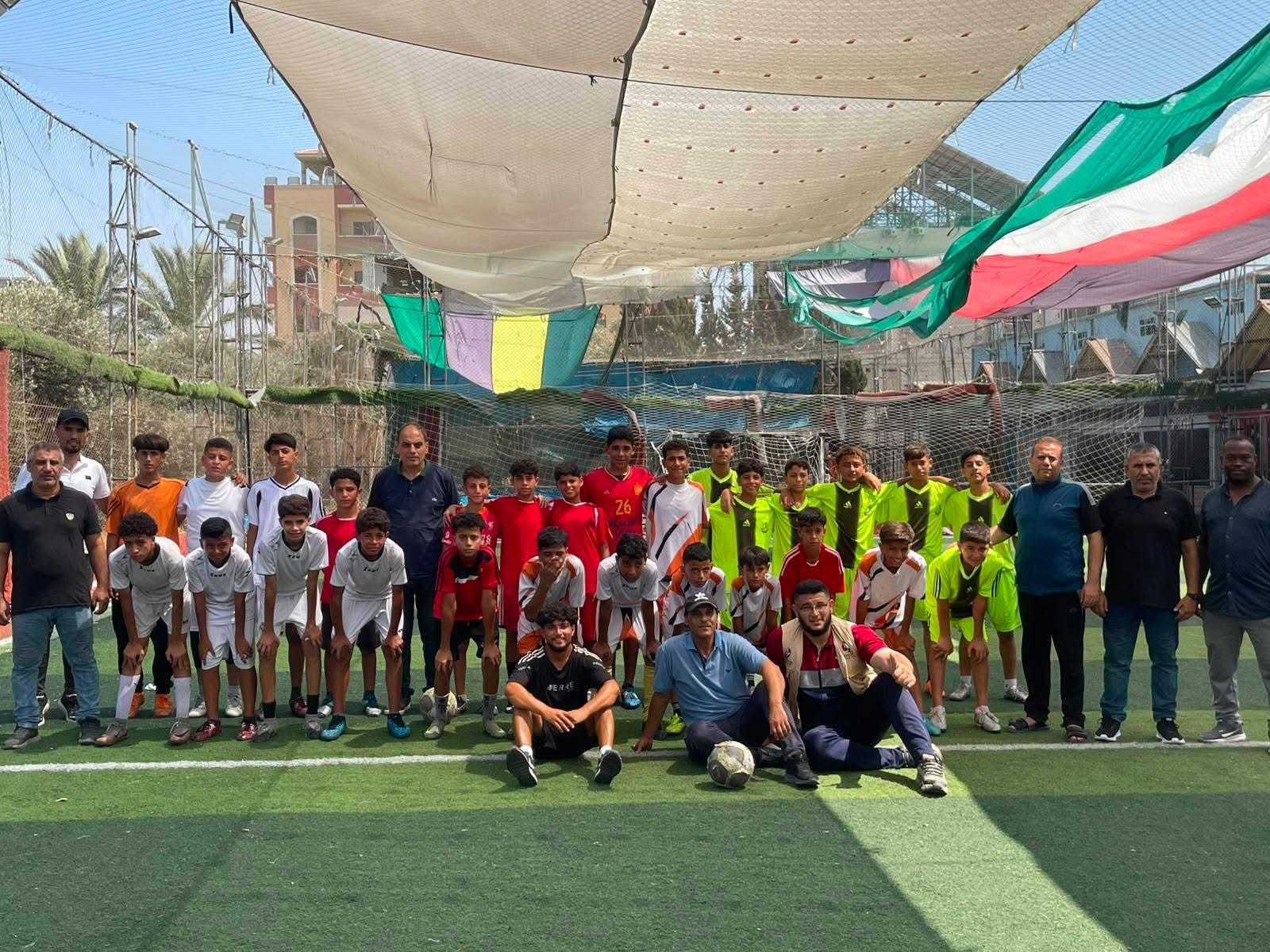
Young players and organizers gather during the Hope Championship for Youth, organized by Al-Aqsa Sports Club on August 13, 2026. Four teams participated across the 2011, 2012, and 2013 birth-year groups, with sponsorship from the Palestine Trauma Centre – UK.
Courtesy of Al-Aqsa Sports Club Media Committee
Al-Aqsa has been part of Nuseirat since 1993. Its crest identifies it as a sporting, cultural, and social institution.
Before October 2023, the club was involved in organized football. Contemporary reporting listed Al-Aqsa among the clubs participating in Palestinian Football Association youth competitions in both 2022 and 2023.
But football was only part of its identity.
Ahmed remembers young players arriving for afternoon training sessions while coaches, parents, and veteran athletes gathered around the pitch. The club also hosted martial arts, chess tournaments, and art exhibitions.
In October 2022, ActionAid Palestine documented its partnership with Al-Aqsa in organizing recreational activities for children, including traditional Palestinian dance and competitions.
Its sporting and social identity predates the war. But Ahmed describes a significant change in its responsibilities after October 2023, as the club became increasingly involved in supporting displaced families and athletes.
During the war, Al-Aqsa also reported providing community assistance. Its published accounts describe distributing food and health parcels and helping provide drinking water to residents. Ahmed explained that these initiatives were documented through photographs and official reports and carried out under the supervision of international partners, including ActionAid.
Football was still appearing alongside those activities.
In March 2025, Al-Aqsa participated in the Martyrs of the Sports Movement Championship, a Ramadan football competition organized by Services Nuseirat alongside a group of former players.
The matches were held at Nuseirat Municipal Stadium, which contemporary reporting described as having sustained damage during the war.
By March 15, Al-Aqsa had accumulated four points in its group and was preparing to face Al-Ribat for a place in the semifinals.
There was organized football taking place in Nuseirat. Teams were competing, results mattered, and a place in the next round was at stake.
But how much could a football match tell us about the condition of the club itself?
In December 2025, Al-Aqsa announced plans to resume structured training with younger players. That announcement followed months in which the club had already reported participating in football competitions.
By August 2026, the club was describing another phase of sporting recovery. Its published records included a youth football tournament, changes to its technical and administrative organization, and renewed first-team activity.
One of those activities was the Hope Championship for Youth, held on August 13. Four teams competed across the 2011, 2012, and 2013 birth-year groups, with support from the Palestine Trauma Centre – UK.
Ahmed told me the tournament was intended to give children somewhere to compete, build confidence, and feel part of a community.
“Even the name ‘Hope’ was chosen deliberately so our young players would feel that they still have a future, a community standing behind them, and a place to simply be kids competing with joy and pride.”
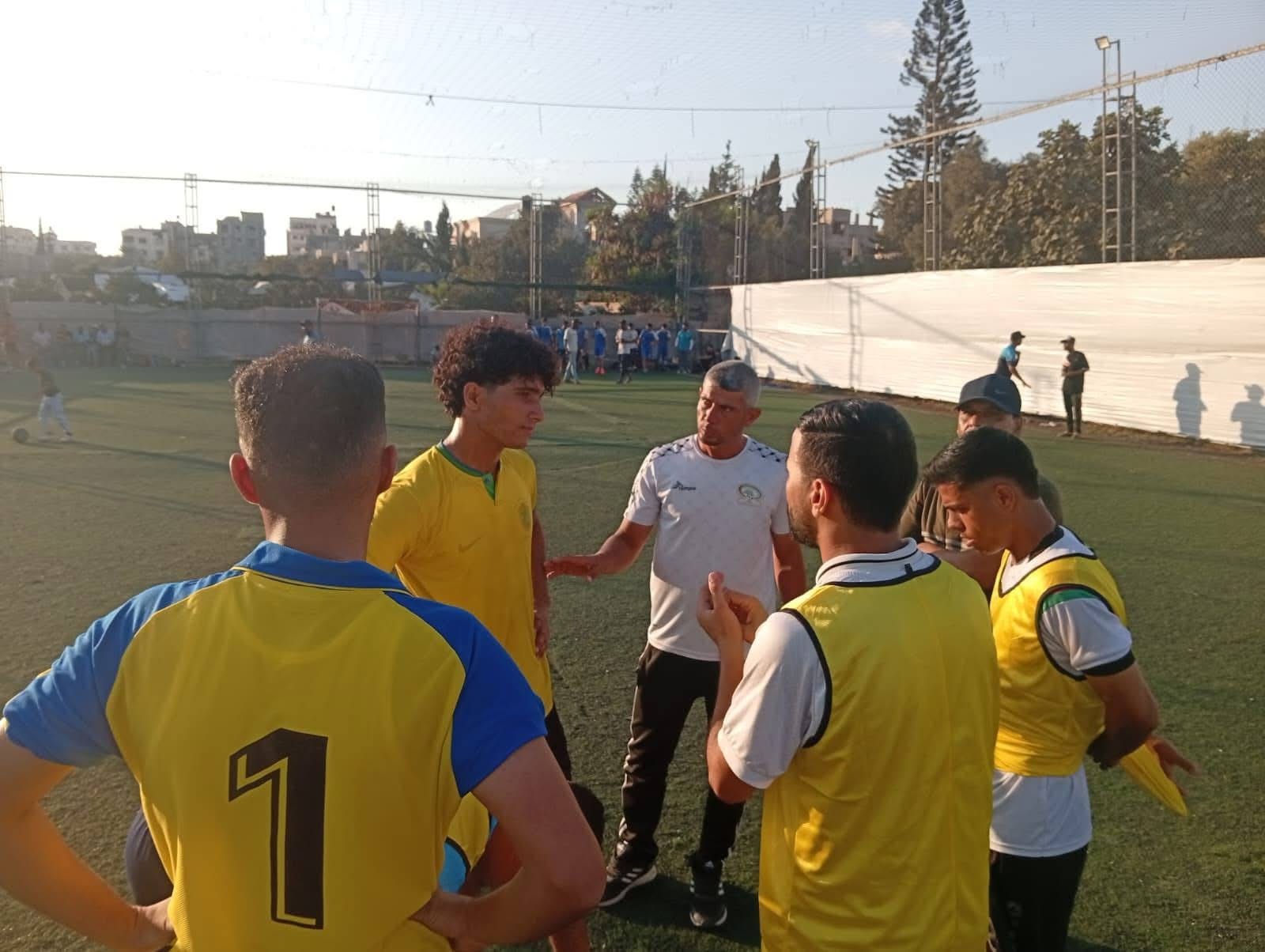
Players and coaches gather during Al-Aqsa Sports Club’s September 4, 2026, first-team friendly against Shabab Al-Zawayda, held as part of the club’s preparations for an upcoming tournament.
Courtesy of Al-Aqsa Sports Club Media Committee
The following month, Al-Aqsa drew 2–2 with Ahli Nuseirat in the Thousand Martyrs Cup, a result also documented by the Palestinian Football Association.
By autumn 2026, Al-Aqsa was reporting youth tournaments, first-team friendlies, and competitive matches. Football had returned to its published calendar. What that looked like between matches was harder to determine.
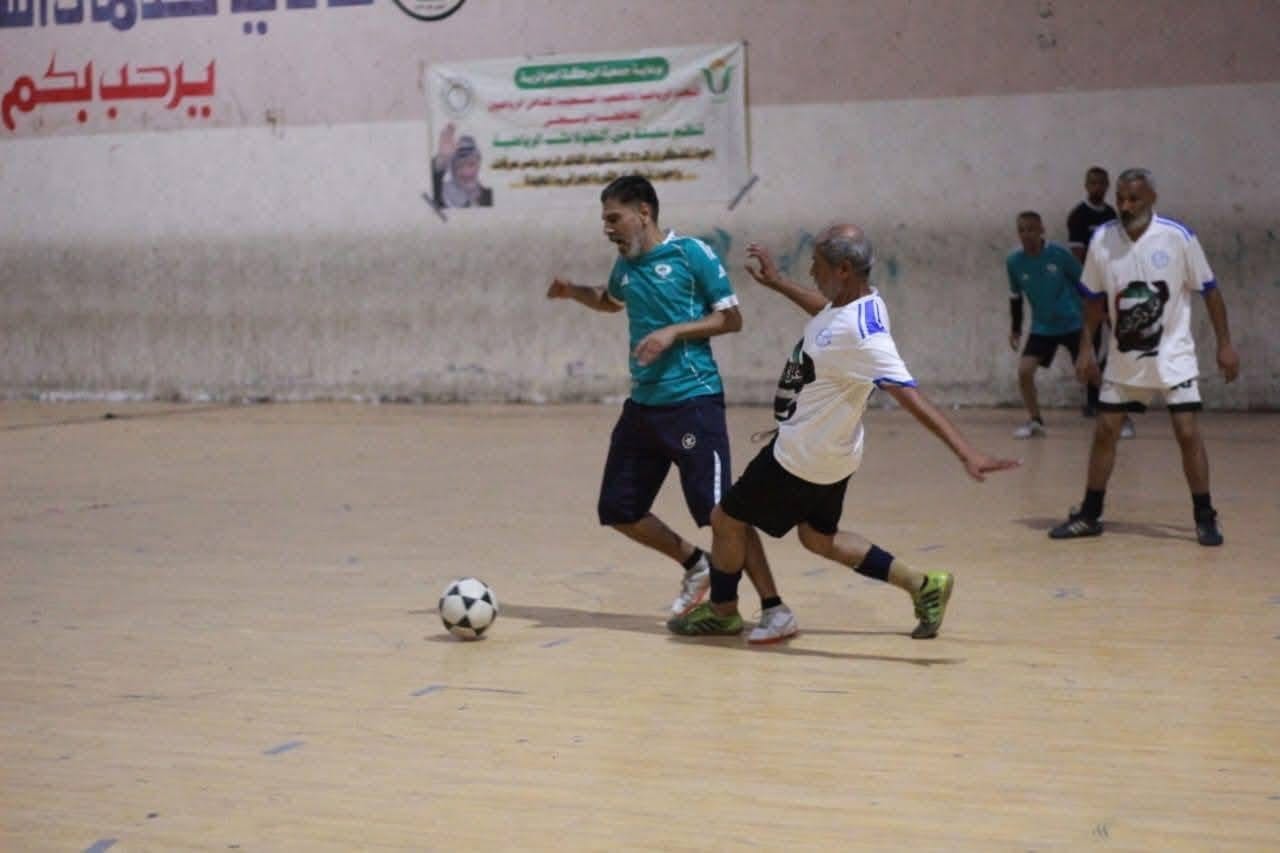
Al-Aqsa Sports Club participates in a Central Governorate championship for veteran athletes on November 9, 2026. Organized by the Veteran Athletes Association, the event featured five-a-side football and handball and commemorated Palestinian leader Yasser Arafat.
Courtesy of Al-Aqsa Sports Club Media Committee
The club’s announcements don’t establish how regularly its teams trained, how many young players participated, or what resources were available to them.
The damage to Gaza’s sporting infrastructure extends well beyond Al-Aqsa. In March 2026, the Palestinian Football Association reported that 265 sports facilities had been damaged or destroyed since October 2023, including stadiums, sports halls, and administrative facilities. Of those, the association classified 184 as completely destroyed. The figures are the federation’s assessment, rather than an independently verified count. Separate United Nations reporting has documented football being played on improvised surfaces, including a former basketball and volleyball court in a displacement camp.
Ahmed describes some of the difficulties behind the club’s records.
Major pitches have been damaged or made inaccessible. Footballs, cones, training bibs, and proper shoes are difficult to obtain. Coaches and players are dealing with displacement, exhaustion, shortages of food and clean water, and the loss of teammates, loved ones, and homes.
Whenever conditions permit, Ahmed says the club’s coaches continue arranging activities for children, including those living in displacement.
Recent club activities have included football drills, a taekwondo course, and an internal chess tournament. Parents watched as their children participated. Ahmed remembers seeing them smile.
The club’s work, as he describes it, extends beyond recreational sport. It also includes educational and cultural activities and assistance to displaced families and young athletes.
Ahmed identifies clean water, food for children during activities, sporting equipment, and financial support among the resources needed to keep those programmes going.
Before a child can enjoy an hour of football, someone has to find a place where it can happen. Someone needs to organize the session. There needs to be a ball, perhaps some equipment, and people willing and able to supervise.
Ahmed has been involved with Al-Aqsa for several years as a volunteer, currently serving as its Administrative and Communications Coordinator. Much of his work involves documenting the club’s activities and maintaining relationships with people outside Gaza.
He’s also a father of four. When he looks at the young players at the club, he sees his own children.
When I asked what he wanted people outside Gaza to understand about the club, he spoke about the children themselves.
He described young players who follow international football, argue about their favorite players, celebrate goals, and dream of playing on a green pitch in peace.
Then he compared the children in Nuseirat to the children I coach in Indianapolis.
That stayed with me.
I spend my days teaching physical education and coaching children who love football. Reading that comparison hit me harder than I can comfortably explain. I’ve watched children light up when a ball comes out, argue over teams, and celebrate goals that mean absolutely nothing beyond the game they’re playing.
The circumstances surrounding their football are profoundly different. But I recognized the children he was talking about.
He wanted people outside Gaza to understand the children themselves, beyond the circumstances in which they’re growing up.
“They do not want pity; they want solidarity, to be remembered as human beings with dreams, and to have the chance to live and play in safety and dignity.”
Readers interested in following Al-Aqsa Sports Club and its ongoing activities can find the club through its official website and Facebook page.
Research & References
This article draws on original correspondence with Ahmed Mahmoud Jadallah, volunteer Administrative and Communications Coordinator at Al-Aqsa Sports Club, conducted in November 2026. Ahmed also reviewed the article for factual accuracy prior to publication.
Additional research draws on:
Al-Aqsa Sports Club—official club history, announcements and activity records.
ActionAid Palestine— documentation of its partnership with Al-Aqsa Sports Club.
Coastal Municipalities Water Utility— reporting on the restoration and maintenance of the club’s desalination plant.
Palestinian Football Association— competition reporting and assessments of damage to sporting infrastructure in Gaza.
Al-Quds, Sanad News Agency and Felesteen— contemporary reporting on organized football and the club’s sporting activities.
United Nations— reporting on football within displacement communities in Gaza.
Where independent verification was limited, information provided by Ahmed or published by the club has been attributed accordingly.
All photographs were provided by the Al-Aqsa Sports Club Media Committee and reproduced with permission.
The words about solidarity rather than pity really stayed with me.
As someone involved in youth football in Japan, I believe every child deserves a place to play, laugh, and dream, no matter where they are born.
Football cannot solve everything these children are facing. But protecting their right to play is part of protecting their childhood and dignity.
Thank you for bringing their voices to us.
Thank you, Kaleb, for telling our story with such care, honesty, and humanity. On behalf of everyone at Al-Aqsa Sports Club—our coaches, volunteers, and most of all, our young players in Nuseirat—we are deeply grateful to you for giving our children a voice and sharing their love for football with readers around the world.
The connection you drew between our kids and the children you coach in Indianapolis truly moved us. Despite everything, football continues to give them moments of joy, belonging, and hope. Thank you as well to every reader who takes the time to read, reflect, and stand in solidarity with our community.
Warm regards,
Ahmed Mahmoud Jadallah
Volunteer Administrative & Communications Coordinator, Al-Aqsa Sports Club – Nuseirat