

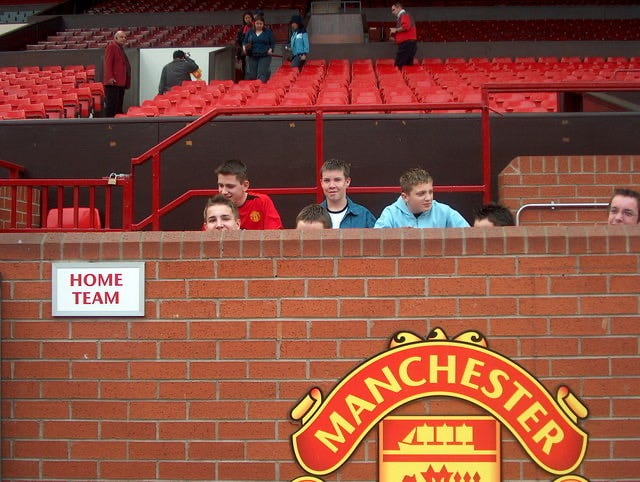
Photo: Paul Thomson, Home Dugout, Old Trafford (2003), via Wikimedia Commons. Licensed under CC BY-SA 2.0.

Manchester United have already shown they can play good football under Michael Carrick.
In January, United beat Manchester City 2–0 at Old Trafford. They defended compactly, protected the middle of the pitch and attacked quickly when opportunities appeared. United’s defensive movements were coordinated, and they were able to exploit the spaces City left available.
Nine months later, United lost 4–1 to Como in the Champions League. Their pressing was far less coordinated. Players moved to close down opponents without consistent support, leaving passing options available and space between United’s lines.
The opposition, personnel and circumstances were different. Two matches can’t establish everything about a manager, much less what happened on the training ground. And while the pressing problems against Como were visible, the footage alone can’t tell us whether they came from the instructions, individual decisions or failures in communication.
If United have demonstrated that they can execute an effective tactical plan, what would it take to make those performances more consistent?
It’s a question that extends beyond Carrick. Erik ten Hag found success by adjusting his approach to the players available. Rúben Amorim arrived with different tactical principles. Each period offered evidence of what United could do, alongside questions about what they could sustain.
Ten Hag’s first season ended with a third-place finish, 75 Premier League points and a League Cup. United had become particularly effective at attacking quickly when opponents left space behind them.
Opta’s expected-points model placed United at 64.21 points that season, nearly eleven fewer than they actually collected.
That doesn’t mean United were lucky to finish third. Expected points estimate results using the quality of chances created and conceded. They aren’t a corrected league table, and they can’t account for every aspect of a team’s performance. Still, the difference raises questions about what lay beneath United’s results.
Carrick’s initial 2026 spell offered another example.
Across his first fourteen Premier League matches in 2026, Carrick’s United collected 32 points. Their expected-goals difference was +2.22, ninth-best in the league over that period. They also scored 27 goals from 20.06 expected goals.
Carrick had made identifiable changes to United’s shape and player roles. The team was winning, and those changes deserve consideration.
The underlying figures, however, suggest that the results were considerably stronger than the balance of chances created and conceded.
That isn’t proof that United were fortunate, or that the improvement couldn’t last. Fourteen matches is a limited sample, and expected goals cannot capture every aspect of a team’s performance.
It does mean the club had more to evaluate than the points total when deciding whether Carrick should lead the team permanently.
These periods aren’t directly comparable. Ten Hag’s figures cover an entire league season, while Carrick’s cover fourteen matches. Expected points and expected-goals difference are different measures, and neither can tell us whether a manager will succeed over several seasons.
They do, however, illustrate why United should be careful about relying too heavily on results when assessing progress.
A team can win while conceding opportunities that may eventually prove costly. It can also improve its performances without immediately seeing those improvements reflected in the table. The difficult part is determining which changes are likely to last.
Ten Hag and Carrick both found success by making use of United’s ability to attack quickly. Does that mean the club should continue building around those strengths?
The football that works with one squad, against one group of opponents, isn’t necessarily the football a club should aim to play five years later.
Amorim’s appointment tested that distinction. He arrived with a recognizable approach built around a back three and wing-backs. United knew what kind of football he had coached successfully before appointing him.
The transition was difficult. Opponents found opportunities around United’s two central midfielders, and the system sometimes left the team exposed.
But the numbers complicate the picture. Across Amorim’s 27 Premier League matches in 2024/25, United averaged 1.24 non-penalty expected goals per game. Through his first eleven league matches the following season, that increased to 1.48.
At the other end, however, non-penalty expected goals conceded rose from 1.34 to 1.51 per match.
United were generating more expected goals in attack, but also allowing opponents more. The samples weren’t equal, and the opening fixtures of 2025/26 were particularly demanding. We can’t attribute those changes entirely to Amorim’s coaching.
There was evidence of attacking development, alongside defensive problems that remained unresolved. That makes it difficult to judge the project from results alone.
A manager should be capable of adapting to the players available. But a club appointing someone for their tactical ideas must understand what those ideas require. Recruitment, development and the time allowed for change are all part of that decision.
United shouldn’t need to rebuild their squad every time they appoint a manager. Equally, insisting that a new coach preserve everything that worked previously would make meaningful change difficult.
The current squad brings that tension into focus.
Matheus Cunha can carry the ball into space. Bryan Mbeumo offers movement across the front line, while Amad can create opportunities in tighter areas. Bruno Fernandes remains an important source of chances, and Benjamin Šeško offers a different presence through the middle.
There are several ways a manager could use those qualities. Finding a combination that consistently produces good opportunities is another matter.
Across United’s opening five Premier League matches of 2026/27, they attempted 113 shots, more than any other team. Yet their average non-penalty expected goals per shot was just 0.08, joint-second lowest in the division.
There was another number worth considering. United had accumulated 9.1 non-penalty expected goals, fourth-highest in the league.
So they were creating a substantial volume of chances, even if the average attempt wasn’t particularly dangerous.
We can’t conclude that United weren’t creating opportunities. But the figures leave questions about where those attempts were coming from, how effectively the available attackers were being used, and whether United could produce a similar attacking threat without relying on so many shots.
Five matches won’t settle those questions. Injuries also affected the combinations available. It’s enough to make them worth examining.
The defensive numbers present a related challenge.
According to Opta, United spent 42 percent of their defensive time in a high block during those opening five league matches, compared with 26 percent during Carrick’s previous spell.
But their higher positioning wasn’t producing many high regains. United recorded 26 high turnovers, fifteenth in the league.
Defending higher requires more than moving players up the pitch. The initial pressure needs support, passing routes need closing, and the defensive line must respond to what happens ahead of it. Otherwise, the spaces United hope to exploit when attacking can become spaces opponents exploit against them.
The January derby demonstrated that Carrick could organize United effectively, although from a more compact defensive position. The defeat to Como showed how difficult that coordination could be to maintain in different circumstances, without establishing precisely why it broke down.
United could examine how a candidate’s teams respond when their initial pressure fails, whether they can create opportunities against organized defenses, and how their approach changes when important players are unavailable.
But the manager isn’t the only person responsible for answering them.
In July 2024, United extended Ten Hag’s contract following a review of the previous season. By October, he had been dismissed.
Amorim arrived the following month with a contract running until 2027.
In October 2025, Jim Ratcliffe publicly argued that Amorim needed three years to demonstrate his ability. Asked whether the club would give him that time, Ratcliffe said yes, pointing to Arsenal’s patience with Mikel Arteta.
Amorim was more cautious. He welcomed the support but acknowledged that football rarely offers those kinds of guarantees.
United dismissed him in January 2026.
That sequence doesn’t establish that the club made the wrong decision. Nor does a public expression of confidence prevent a club from responding to changing circumstances.
But it does leave a question about what United considered sufficient evidence to change direction, particularly after publicly emphasizing the importance of patience.
Carrick’s permanent appointment makes that question particularly relevant.
His initial spell produced excellent results and helped secure Champions League qualification. United had identifiable reasons to retain him. But the underlying numbers also offered grounds for caution.
What expectations did the club establish for the next stage?
We don’t know.
We can examine the appointments, public statements and performances. We can’t establish what was discussed internally, which indicators United prioritized or how they intended to evaluate the longer-term project.
Those limits shouldn’t prevent us from examining the responsibilities involved.
A head coach controls much of the team’s preparation, organization and tactical development. The club determines who holds that position, influences the squad through recruitment and decides how the coach’s work will be judged.
If United want to defend higher, the available players must be capable of supporting that approach. If they want greater control in possession, recruitment and coaching need to work toward the same objective. And if they expect a difficult transition, they need to distinguish between problems that come with development and problems that suggest the approach itself isn’t working.
That doesn’t require United to commit indefinitely to any manager. It requires clarity about what they’re asking that manager to accomplish.
What does Manchester United actually need from its next manager?
The evidence doesn’t point toward one formation or a particular possession figure. United have played effective football in different ways, and the current squad has qualities worth building around.
For United, that means examining whether a coach has demonstrated an ability to organize a team collectively, create opportunities against different defensive approaches, and adjust when opponents begin finding answers.
That standard applies to Carrick as much as anyone United might consider replacing him with.
His early success shouldn’t be dismissed because the underlying numbers were less impressive. Nor should those results settle the question of whether he’s the right person to lead the next stage.
The same scrutiny should apply to an external candidate. Previous trophies, an established tactical identity or an impressive opening spell can all provide useful evidence. None tells United everything about how that coach would work with this squad or develop it over time.
There isn’t a reliable formula for identifying the perfect appointment. We also don’t know how closely United’s internal assessments already resemble the standards we’ve explored.
But the club can examine what a candidate’s teams have actually improved, how those improvements were achieved, and what happened when their initial approach encountered difficulties.
Then United have to decide whether they’re prepared to provide what that approach requires.
Research & References
This article draws on official Manchester United announcements, Premier League records, Opta analysis, and original reporting from BBC Sport and other football journalists. Sources are linked throughout the article where the relevant findings and statements are discussed.
The statistical comparisons cover different periods and measure different things. Erik ten Hag’s expected-points figures relate to the full 2022/23 Premier League season, while Michael Carrick’s expected-goals figures cover his first fourteen league matches in 2026. Expected points and expected-goals difference are not interchangeable, and neither provides a definitive assessment of a manager’s performance.
The figures examining Rúben Amorim’s time at United compare 27 league matches in 2024/25 with eleven in 2025/26. The analysis of United’s attacking and defensive performances under Carrick in 2026/27 covers the opening five league matches. Those differences in sample size, opposition and circumstances limit what can reasonably be concluded.
The tactical observations about United’s matches against Manchester City and Como draw on match footage and published analysis. They describe how United defended and pressed in those matches, but cannot independently establish the instructions given to players or the reasons those instructions may not have been carried out.
The article also examines United’s managerial appointments, contract decisions and public statements. Those records establish what the club announced and what its representatives said publicly. They do not reveal the internal criteria used to assess managers or the discussions behind individual decisions.
These limitations matter when considering what United should require from its next manager. The evidence can identify strengths, weaknesses and questions worth asking. It cannot establish which candidate would succeed, whether the club already uses similar evaluation methods, or how any particular appointment would develop over several seasons.
If you were responsible for choosing Manchester United's next manager, what would you look for beyond results?