

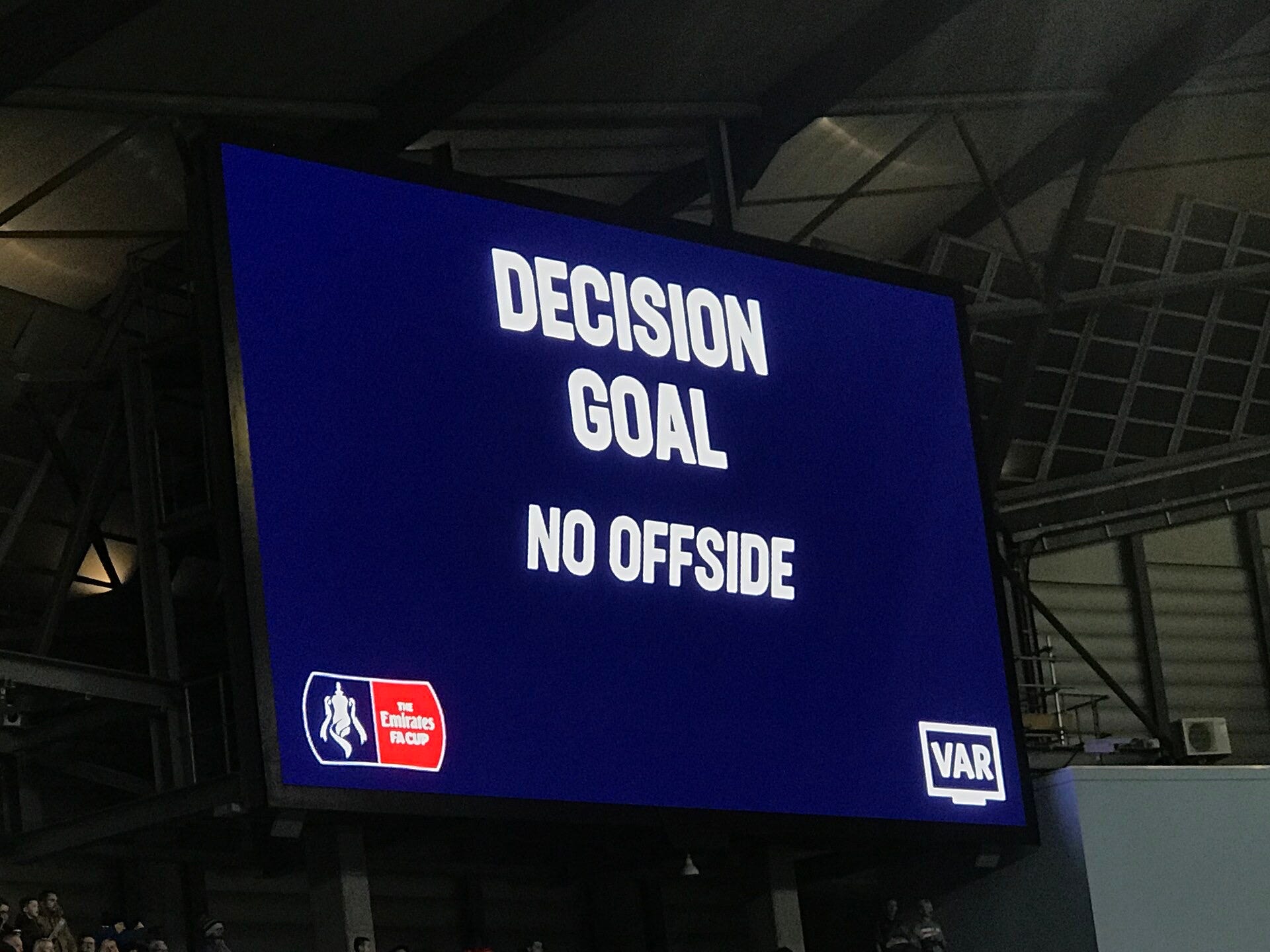
Photo: Rlwjones / Wikimedia Commons, VAR decision during an FA Cup match at the Etihad Stadium, Manchester (4 January 2020). Licensed under CC BY-SA 4.0.
In the 72nd minute at Stamford Bridge, Cole Palmer played Estêvão through on goal. The Brazilian finished high into the Manchester United net.
The goal didn’t stand.
Officials reviewed the decision and ruled Estêvão offside. It was his second disallowed goal of the afternoon.
There’s nothing particularly controversial about disallowing an offside goal. If a player is offside, the goal shouldn’t count. Having technology available to help officials get those decisions right seems difficult to argue against.
But the ball had crossed the line. The goal had initially been awarded. Then it was taken away.
Football has always had incorrect decisions, including ones that changed matches. VAR was introduced to correct some of the most consequential mistakes. And there is evidence that it does.
According to the Premier League’s Key Match Incidents Panel, 88% of 138 selected referee incidents through the first seven rounds of the 2026/27 season were judged correct on the field. After the VAR process, that figure rose to 99%.
Those figures don’t cover every decision made during those matches. They’re judgments made by a panel applying the laws and the league’s officiating framework. But they do show that VAR has corrected mistakes that otherwise would have stood.
That matters. A wrongly disallowed winner or an incorrectly awarded penalty can change a match. Removing VAR would mean accepting that some of those mistakes would go uncorrected.
What surprised me when looking into the system was how much its designers had already considered the potential cost of those corrections.
During VAR’s original development, the International Football Association Board described its philosophy as “minimum interference – maximum benefit.” The intention was to correct consequential errors while protecting the flow and emotion of football.
IFAB’s rules try to manage that trade-off. VAR can only examine certain incidents, and overturning a subjective decision requires a high threshold. Offside positions are treated differently because they’re considered factual decisions.
But limiting interventions doesn’t mean limiting checks. Every potential goal is checked, even if the decision eventually stands. Most of those checks happen without a formal review, and some without a noticeable delay.
The number of overturned decisions tells us little about how often supporters actually experience a delay, or how those delays affect them.
IFAB requires reviews to be completed efficiently, although accuracy takes priority over speed. There is no maximum time limit.
The rules explain why officials can spend time reviewing a goal. They don’t tell us how supporters feel about waiting.
In March 2026, the Football Supporters’ Association published a survey completed by nearly 8,000 respondents. Among them, 91.6% agreed that VAR had removed the spontaneous joy of goal celebrations.
Overall, 75.7% opposed VAR’s continued use.
The survey was voluntary, so respondents may have been more motivated to participate if they held strong opinions about VAR. We can’t assume these percentages represent Premier League supporters generally. But the dissatisfaction among those who answered is difficult to overlook.
One finding was particularly revealing. Despite those views on VAR, 93% supported retaining goal-line technology.
Both systems use technology to assist officials, but they operate differently. Goal-line technology answers whether the ball has crossed the line and generally communicates its result almost immediately. VAR can involve judgments about contact, interference or other aspects of an incident.
The survey doesn’t establish whether speed, scope, certainty or something else explains the difference in support. It does establish that these respondents didn’t object equally to every use of officiating technology.
That raises another question. Are supporters rejecting VAR itself, or the way it currently works?
In May 2026, YouGov surveyed 434 British adults who watched Premier League football at least fairly regularly. It found that 72% believed VAR had made watching matches less enjoyable.
Yet 68% wanted VAR retained with changes. Only 18% preferred removing it entirely.
That’s a considerable contrast with the FSA’s findings. The surveys used different methods, reached different groups and asked differently worded questions, so their percentages aren’t directly comparable.
Still, both found dissatisfaction with the experience of watching football under VAR, while producing very different answers about what should happen next.
The Premier League has been trying to address some of that frustration. Semi-automated offside technology is intended to speed up certain decisions, while referee announcements and improved communication are meant to explain what’s happening.
Those are reasonable changes. But faster decisions may not entirely solve the problem supporters are describing. They could simply shorten the time spent waiting for an answer.
There is another side to that uncertainty. A goal incorrectly allowed to stand can be just as consequential for the team and supporters on the receiving end. VAR gives officials an opportunity to correct it.
We have evidence that the technology improves the accuracy of selected decisions. We also have evidence that many survey respondents believe it has made football less enjoyable. What we don’t have is a reliable way to determine how much of that dissatisfaction comes from waiting, uncertainty, disagreement with decisions or some combination of them.
Nor can we establish whether the changes being introduced will restore the spontaneity supporters say they’ve lost.
At Stamford Bridge, Estêvão’s goal was initially awarded, then overturned. Officials judged him offside, and VAR gave them the opportunity to correct the decision.
That’s a meaningful improvement.
But IFAB’s original ambition wasn’t only to correct mistakes. It was to do so with as little interference as possible.
The Premier League measures the decisions VAR corrects, and it asks supporters about their experience. What I haven’t found in the published evidence is a clear way to judge whether the balance between the two is the one football originally intended.
Research & References
This article draws on official Premier League match reporting, the league’s Key Match Incidents Panel findings, the International Football Association Board’s VAR protocol and original documentation, and supporter research published by the Football Supporters’ Association and YouGov. Source links are provided throughout the article where the relevant incidents, figures and statements are discussed.
The Premier League’s officiating accuracy figures concern 138 selected referee incidents from the opening seven rounds of the 2026/27 season. They reflect the judgments of the Key Match Incidents Panel and should not be interpreted as accuracy rates for every refereeing decision or every VAR check.
The supporter surveys also require care. The FSA’s March 2026 survey was voluntary and attracted nearly 8,000 respondents. Its results cannot be assumed to represent all Premier League supporters. YouGov’s May 2026 findings came from 434 British adults who watched Premier League football at least fairly regularly. The surveys reached different groups, used different methods and asked different questions. Their percentages are not directly comparable.
IFAB’s protocol establishes the procedures and principles governing VAR, including the distinction between automatic checks and reviews. It does not establish how frequently supporters experience noticeable interruptions or how those interruptions affect their enjoyment of matches.
These limitations matter to the article’s conclusion. The available evidence supports VAR’s contribution to correcting selected officiating decisions and documents dissatisfaction among surveyed supporters. It does not establish the precise causes of that dissatisfaction or whether the current balance between accuracy and interference is the one football’s governing bodies originally intended.
What do you think?
Would you accept more incorrect decisions if it meant celebrating goals without waiting for VAR, or is getting those decisions right worth the uncertainty?
Really good study Kaleb and a great question to ask. The contrast with goal-line tech is such a good one: I see goal-line tech as a calculator - it speeds up the process towards an objective truth (hard to argue with and universally agreed) whereas VAR is more like an interpreter - same input, potentially varying outcomes, guaranteed subjectivity. I've come to accept VAR, and it does work fairly well now, but it has changed a lot about the game, and as a matchgoing fan I preferred it before.