

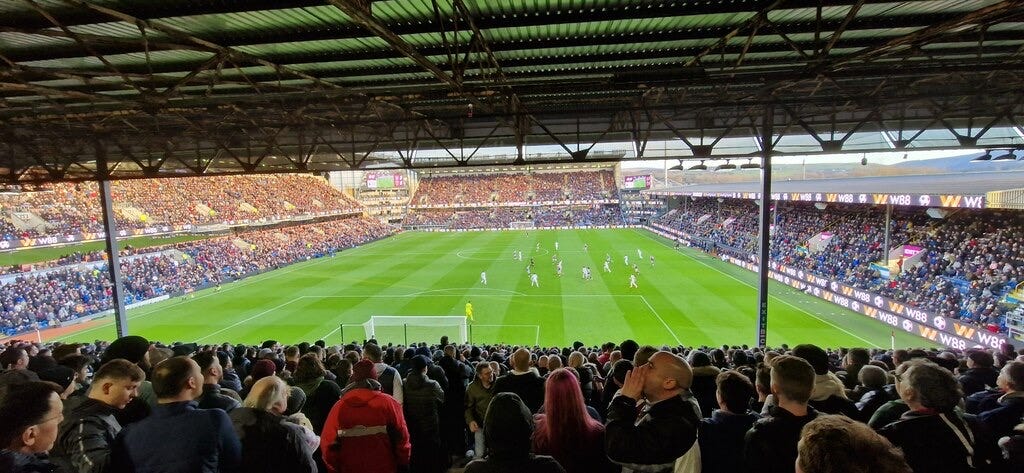
Turf Moor, Burnley. Photograph by Elliot Smith (2023), via Wikimedia Commons / Geograph Britain and Ireland. Licensed under CC BY-SA 2.0.
Manchester United’s agreement with adidas contains a provision concerning relegation.
If United were relegated from the Premier League, adidas could reduce its applicable payments for a year by 50%. The company could also terminate the agreement with a full season’s notice.
United have never been relegated from the Premier League. But the possibility is written into one of their biggest commercial agreements.
The loss of Premier League broadcasting revenue would be substantial. Future European competition income could also be affected. And the adidas agreement suggests that even the commercial relationships helping support these enormous clubs might not be entirely protected.
The financial commitments made before relegation wouldn’t necessarily disappear alongside that income.
Players would still have contracts. Transfer payments would still come due. Borrowing arrangements would still need to be serviced.
What would relegation actually mean for a club operating at this scale?
And would the consequences be the same for Liverpool, Arsenal, Chelsea, Manchester City or Tottenham?
Manchester United reported £677.6 million in revenue for the financial year ending June 2026.
Of that, £206.8 million came from broadcasting, £317.3 million from commercial activities, and another £153.6 million from matchdays.
The broadcasting money is the most obvious place to look. United’s broadcasting revenue includes income from domestic competitions and European participation. That income would look very different in the Championship.
But the other two categories aren’t guaranteed to remain unchanged either.
Old Trafford wouldn’t suddenly become smaller, and United wouldn’t lose their supporters simply because they were playing in a different division. But ticket prices, hospitality demand and the number of home fixtures could all affect what the club actually earns.
United’s own financial reporting acknowledges that relegation would adversely affect matchday revenue, although some expenses could fall alongside it.
There isn’t one number we can subtract from £677.6 million to find out what United might earn as a Championship club.
Liverpool reported more than £700 million in revenue in 2024–25. Arsenal and Manchester City were close behind. Tottenham exceeded £560 million, while Chelsea approached £500 million.
Each club earns its money through a different combination of broadcasting, commercial relationships and matchday activity. Relegation wouldn’t affect every part of those businesses equally.
A club with a particularly strong commercial operation might retain more of its income than one heavily dependent on broadcasting. But as United’s adidas agreement demonstrates, even commercial revenue cannot automatically be treated as protected.
At the end of June 2026, United owed approximately £375 million in transfer fees and associated costs. Around £218 million was due within the following twelve months.
That isn’t money United would suddenly owe because of relegation. It’s money the club had already committed to paying.
Manchester City reported an even larger figure in its June 2025 accounts. It owed approximately £423 million in transfer payments, with close to £170 million due within a year.
Paying for transfers in instalments is a normal part of modern football. Clubs also receive payments when they sell players. These figures aren’t necessarily evidence that either club is in financial difficulty.
But those instalments don’t automatically disappear when a club changes divisions.
At June 2026, United had £67.2 million in cash and approximately £689 million in borrowings. It also had access to a revolving credit facility, with £290 million undrawn at the reporting date.
The club receives money throughout the year from commercial agreements, ticket sales and other activities. Those receipts don’t necessarily arrive at the same time as its payments.
United’s directors concluded that the club could meet its obligations for at least twelve months following the date of the annual report.
That assessment was made while United remained in the Premier League.
Relegation would change the income available to support those commitments. How much it changed, and how quickly the club could adjust, would determine whether the problem became more serious.
Some costs might fall. Players could be sold. Owners could provide additional funding.
But those decisions would have consequences of their own, and none can be assumed in advance.
Burnley, Sheffield United and Luton Town were all relegated from the Premier League in 2023–24. Their financial results the following season offer some perspective.
Burnley’s annual revenue fell from £133.6 million to £71.7 million.
The club reported £59 million in profit from selling player registrations. Even with that contribution, Burnley recorded a £28.5 million loss after tax.
Its wage-to-turnover ratio also rose from 69.94% in the Premier League to 114.65% in the Championship. That doesn’t necessarily mean the club was paying its staff more. Wages simply represented a much larger proportion of its revenue.
The accounts contained another concern.
Auditor BDO identified a material uncertainty related to Burnley’s ability to continue as a going concern if player-trading results and expected payments from its parent company fell materially short of forecasts.
The auditor’s opinion remained unmodified. It did not conclude that Burnley was insolvent or unable to continue operating.
Burnley were promoted straight back to the Premier League. Their sporting success, however, doesn’t tell us whether the financial risks identified by the auditor were resolved.
Sheffield United experienced a similar decline in revenue, from £137.6 million to £79.3 million.
Their accounts also showed something particularly relevant to United’s adidas agreement.
Sponsorship and advertising income fell from £7.3 million to £3 million. The club attributed that reduction to the loss of more lucrative Premier League sponsorship arrangements.
The club also reported £25.4 million in profit from player sales, helping offset an operating loss of £16.6 million.
Sheffield United finished third in the Championship and lost the playoff final.
Luton Town’s experience was different.
Their revenue fell from approximately £132.3 million to £66.8 million. The club had included relegation clauses as standard in its player contracts.
Those provisions helped Luton reduce costs following relegation. Player sales also contributed to its financial position.
Luton reported an operating profit but finished 22nd in the Championship and were relegated again.
Burnley returned immediately despite recording a significant financial loss and carrying a material going-concern uncertainty in its accounts. Sheffield United reached the playoff final after reporting a small profit. Luton reduced costs and reported an operating profit but still dropped another division.
In 2024–25, the Championship’s 24 clubs generated £942 million in combined revenue. According to Deloitte, they also recorded £436 million in operating losses.
Promotion offers access to an entirely different level of income, and clubs are spending considerable amounts trying to reach it.
But the money isn’t distributed evenly.
Clubs relegated from the Premier League can receive parachute payments to help them adjust to the loss of top-flight income.
A September 2026 report from Leonard Curtis and Loughborough University examined ten seasons of Championship finances.
Between 2015–16 and 2024–25, clubs receiving parachute payments generated an average of £59.7 million in annual revenue. Those without them averaged £21.3 million.
The difference extended to promotion.
Parachute-payment clubs were promoted in 31.4% of their Championship seasons, compared with 7% for clubs without those payments.
That doesn’t mean the payments alone caused those promotions. Relegated clubs often arrive with stronger squads, facilities and other advantages built during their time in the Premier League.
Beginning in 2026–27, the EFL replaced the Championship’s Profitability and Sustainability Rules with Squad Cost Rules.
The new framework links permitted spending on players and the first-team manager to a club’s eligible income, including relevant turnover, net player trading and limited owner-equity funding.
The spending limit isn’t the same amount for every club.
A club generating more qualifying income can generally support a larger playing budget. And while there are transitional arrangements for clubs relegated from the Premier League, they aren’t exempt from the rules.
The regulations are intended to improve financial sustainability. Whether they will narrow the existing differences between Championship clubs remains to be seen.
Now consider a club with the commercial operation of Liverpool, Arsenal or Manchester United entering that division.
Its broadcasting income would fall. Some commercial arrangements could become less valuable. Existing financial commitments would still need to be managed.
The published accounts don’t disclose every contractual provision that could affect commercial revenue following relegation.
But the scale of these clubs’ existing commercial operations raises the possibility that they could remain considerably wealthier than many Championship competitors, even after suffering substantial losses.
The spending rules would apply to them too. Those rules wouldn’t necessarily remove the difference in qualifying income.
A club could be financially weaker than it was in the Premier League while remaining stronger financially than much of the division it had entered.
Manchester United’s adidas agreement doesn’t tell us what relegation would ultimately cost the club.
It tells us that at least one major commercial partner has accounted for the possibility.
The accounts establish the scale of the financial commitments these clubs have made. What happens to those commitments following relegation would depend on the income clubs retained, the players they sold, the contracts they could renegotiate and the financing available to them.
So would relegation threaten the financial stability of an English giant?
It could.
Burnley’s accounts demonstrate that even an immediate return to the Premier League doesn’t necessarily tell us how comfortably a club managed the financial consequences of relegation.
But the evidence doesn’t establish that an English giant would collapse financially. Nor does it guarantee an immediate return to the Premier League.
A club with the commercial reach of Manchester United, Liverpool or Arsenal could arrive in the Championship facing serious financial pressure while still possessing resources that many of its competitors couldn’t match.
Whether that would be enough to secure promotion is another question.
The accounts don’t give us that answer.
Research & References
This piece draws on audited financial statements and annual reports from Manchester United, Manchester City, Burnley and Sheffield United, alongside financial disclosures from Luton Town. It also uses Deloitte’s Annual Review of Football Finance, research published by Leonard Curtis and Loughborough University, and the English Football League’s financial regulations.
Where possible, I have relied on primary sources, including club accounts, regulatory documents and official financial reporting. Links to the relevant sources are included throughout the article.
The financial figures cover different reporting periods. Manchester United’s figures are drawn from its financial year ending June 2026, while the wider club comparisons primarily use 2024–25 accounts. Revenue, operating profit, profit from player sales and outstanding transfer payments are separate measures and should not be treated interchangeably.
The experiences of Burnley, Sheffield United and Luton Town provide evidence of the financial consequences of relegation, but they cannot establish exactly what would happen to a club with the commercial reach of Manchester United, Liverpool or Arsenal. Individual sponsorship agreements, player contracts, financing arrangements and ownership decisions could materially change the outcome.
This investigation does not assume that relegation would cause financial collapse or guarantee an immediate return to the Premier League. It examines what the available financial evidence can establish, and where the limits of that evidence remain.
Research and financial information reviewed through November 2026.
What do you think?
Could an English giant survive the financial consequences of relegation while retaining an advantage over the clubs already competing in the Championship? Or would the loss of Premier League income prove more damaging than its commercial strength could overcome?