

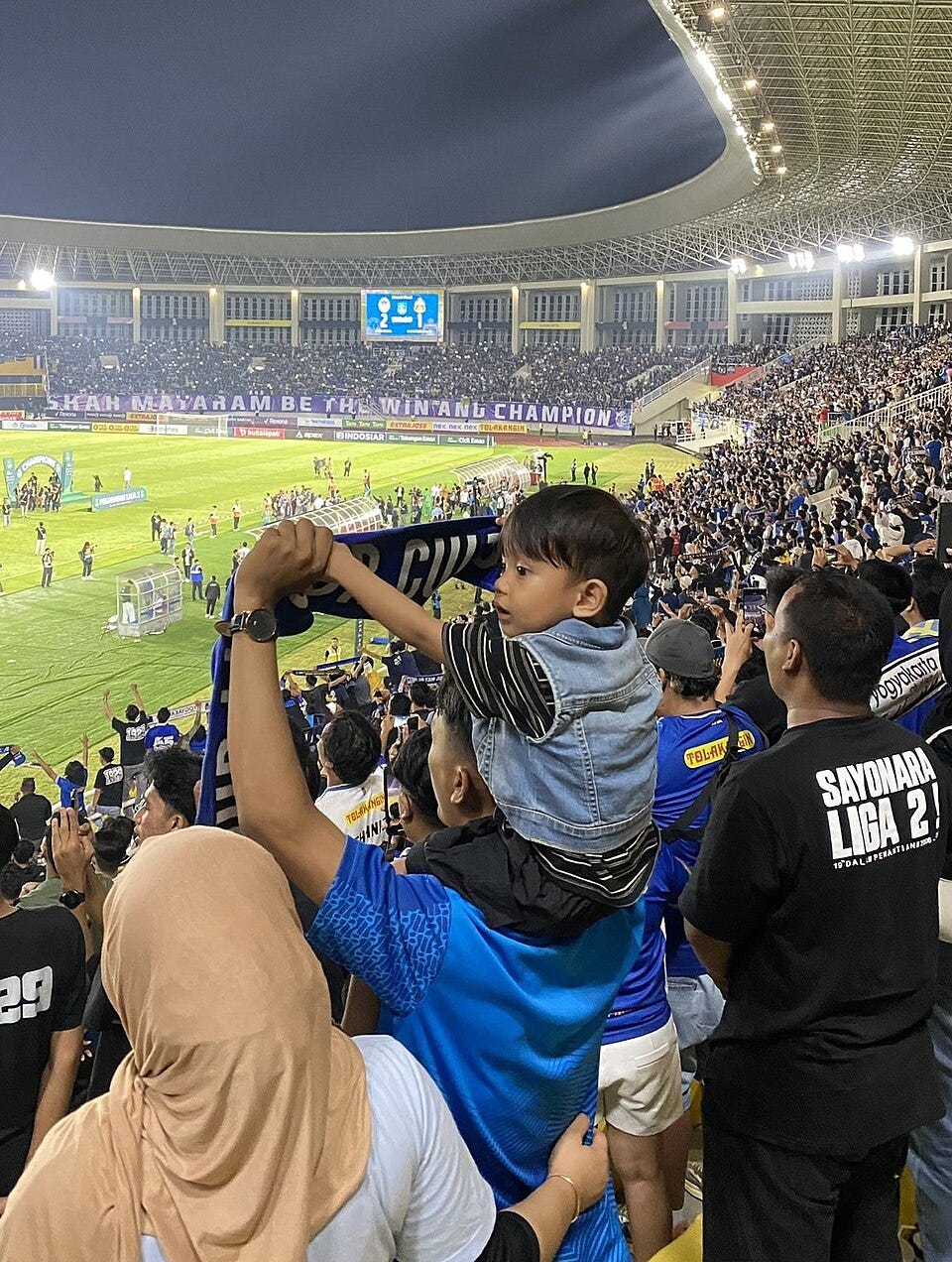
Young PSIM Yogyakarta supporters at Manahan Stadium. Photo: Altair Netraphim / Wikimedia Commons, CC BY 4.0.
Nobody is born caring about a football club.
Somebody has to put it in front of you first.
Maybe that happens at home. Your dad puts you in the shirt before you know what the badge means. Maybe the club is already part of the city around you, close enough that supporting it never feels like much of a decision. For somebody else it starts on television. A player, a goal, a shirt, a match you happened to catch and then, for whatever reason, wanted to see again.
There usually isn’t much ceremony to it.
That’s the part I keep coming back to.
Because the beginning can be almost accidental, and somehow years later people are arranging weekends around fixtures played by strangers. Songs get learned. Trips get planned. Kids get pulled into it. A match from twenty years ago can still put somebody back in a specific room, next to a specific person, at a very specific point in their life.
We call a lot of that football culture.
I realized pretty quickly I wasn’t sure what I meant by that.
My first thought was that the difference had something to do with participation. Watching was consumption. Building something around the game was culture.
That explanation lasted about as long as it took me to start researching it.
Supporters can form intense attachments to clubs in cities they have never lived in. Real relationships can grow around a product sold by a multinational entertainment business. Supporters create songs and traditions that clubs eventually package and market. Parents pass clubs to children who promptly decide they like somebody else.
The boundary kept getting harder to see.
Maybe there isn’t a point where football stops being entertainment and becomes something more.
Maybe the better question is what starts collecting around it.
The most obvious answer is repetition.
Football never really goes away.
There is another fixture coming. Another Saturday. Another reason to check the score, meet somewhere or send the same person a message. Even a team doing absolutely nothing interesting still gives you a calendar.
But doing something over and over does not automatically make it meaningful.
Sometimes a habit is just a habit.
The interesting part is what starts attaching itself to it.
Sociologist Mitchell Lee got an unusual chance to watch some of that happen almost from scratch. During New York City FC’s inaugural season, he studied the development of the club’s singing culture. This was not a tradition with generations behind it. The club barely had a past.
Supporters still began settling into repeated behaviors.
Songs became part of how an emerging group understood what we do here.
Lee is actually careful about calling what he observed a “community.” The word can imply permanence and cohesion that fluid supporter groups do not always have.
That distinction matters.
Football writers, clubs and supporters use community pretty freely. Sometimes what we are really talking about is attachment. Sometimes shared behavior. Sometimes there are durable relationships underneath it.
Those things can overlap without being the same thing.
There is evidence for the relationships, though. Research using social-network analysis around an MLS club and a USL club in the American Midwest found measurable networks of co-attendance among supporters. Shared supporters-group membership and interaction around the team were associated with stronger ties within those networks.
That does not mean football manufactures friendship.
It means football gives people a reason to keep ending up in the same place.
A fixture can become the excuse for the conversation. After a while the conversation becomes part of the fixture. Eventually it can be hard to tell which part you were really coming back for.
Places pick up meaning too.
A stadium is concrete, steel and plastic seats until enough life happens there.
Then one section becomes where you stood with your dad. One pub becomes the place everybody met. One street becomes a walk you know without thinking about it.
Research into the abandoned Za Lužánkami stadium in Brno looked at exactly that connection between football grounds and collective memory. Zbrojovka left the ground in 2001. Fourteen years later, supporters helped revive the abandoned stadium long enough to stage an exhibition match there.
The football had moved on.
The meaning attached to the place had not.
That is probably what repetition gives us more than anything else: chances for football to get tied to people, places and parts of our lives that were never really about football to begin with.
Then somebody else gets brought into it.
Research by Simone Sarti involving more than 4,000 University of Milan students found early family socialization to be an important mechanism in the transmission of football fandom. The sample is not representative of every supporter everywhere, but it gives some weight to something football families already understand pretty well.
We hand this stuff to each other.
Not just shirts.
Routines. Stories. Knowledge. Places. Ways of spending time.
But inheritance is messy.
Kevin Dixon’s work on becoming a football fan pushes against the idea that tradition simply reproduces itself intact. People receive practices inside particular social conditions, then interpret them. Change them. Sometimes resist them completely.
Ilan Tamir deliberately studied fathers whose sons supported different clubs. For some of those fathers, the choice disrupted expectations around family legacy and team heritage.
The sons had not failed at being football supporters.
They had just done something different with what had been handed to them.
A parent can pass down Saturday afternoon without successfully passing down the club. A sibling can introduce the game and watch the other person build a completely different relationship with it. A family can move thousands of miles and carry a football identity somewhere the club itself has never been.
What gets handed over is really just the starting point.
Before digging into the research, I had asked a few people around me a deliberately simple question:
Why does football matter to you?
It wasn’t a survey, and I wasn’t trying to prove anything with the answers. I just wanted to see where people went when the question was left open.
What caught my attention was how quickly football gave way to people.
They talked about brothers, friends, parents and children. Playing together. Watching together. Having something to fall back on as relationships changed.
I kept coming back to one word: heritage.
Not heritage as perfect inheritance. Football rarely works that neatly.
You can inherit the ritual, the stories, even a way of spending time with people.
You cannot inherit somebody else’s memories.
Those have to become your own.
The ritual can be handed over.
The meaning has to be made again.
Heritage also sounds sturdier than it really is.
Sometimes the next person does not want what they are being handed. Sometimes the club changes. Sometimes the people around it change. Sometimes the place disappears. Sometimes the practical conditions that allowed the ritual to repeat become harder to maintain.
A recent study of English supporter activists campaigning against rising ticket prices and reductions in youth and senior concessions found that their concerns went beyond simply paying more for football.
They were worried about what gets interrupted: grandparents taking children, parents sitting with sons and daughters, season tickets remaining in families, going back to the same ground together year after year.
Their argument was that access helps make those repetitions possible. If enough of that becomes harder, passing the practice forward becomes harder too.
That does not mean an older version of football culture deserves automatic protection.
Traditions can pass along exclusions and assumptions about who counts as a “real” supporter just as easily as they pass along songs and stories.
Commercial football complicates the picture even more.
The forces that have made clubs easier to follow around the world can exist alongside pressures making some forms of traditional matchgoing harder to sustain.
Broadcasting carries the match.
Marketing carries the badge.
Digital spaces give distant supporters somewhere to gather.
Then people start doing things with what arrived.
They create routines, group chats, trips, jokes, friendships and supporter groups the club never fully planned.
And eventually some of that becomes commercially useful too. Clubs can market an atmosphere and identity supporters helped create themselves.
At that point, trying to sort everything neatly into “commercial” or “authentic” stops being especially useful.
A club can profit from something supporters genuinely built together without making what they built fake.
So when do the roots of the badge reach the heart?
I am not sure there is a moment you could point to.
Buying the shirt does not do it.
Knowing every player does not do it.
Neither does attending some magic number of matches or supporting the same club for forty years.
Forty years can describe meaning.
It can also describe habit.
The difference seems to be how much else gets attached along the way: a morning routine, a person, a place, a particular season, a trip, even a story you have heard enough times that you remember it despite never being there.
One match becomes the afternoon you spent with somebody. One stadium becomes a place where somebody still exists in your memory long after they stopped sitting beside you.
Eventually football starts carrying things that are not really about football anymore.
That does not make any of it permanent.
What gets handed down can change enough that the people who started a tradition barely recognize what survives.
Maybe surviving was never going to mean staying exactly the same.
The badge itself can travel almost anywhere now.
A broadcast can put it in front of millions of people. A shirt can be shipped across the world. A club can collect supporters on another continent before some of them ever see its stadium.
Meaning does not move that easily.
Somebody has to make something out of what arrives.
And if it is going to last beyond them, somebody else eventually has to make something out of it too.
Maybe there was never going to be a clean answer to when that happens.
Not when football becomes impossible to separate from who you are.
When it becomes difficult to separate it from the people, places and memories through which you learned to care.
Research & References
This piece draws on peer-reviewed research in football sociology, supporter behavior, cultural transmission, social identity, collective memory and intergenerational fandom.
Where possible, I have linked directly to the underlying academic studies rather than summaries of their findings. The studies used here examine different supporter populations, clubs, countries and methods, so their findings are treated as evidence of particular mechanisms rather than universal rules about how all football supporters experience the game.
Several of the studies used in this piece are deliberately narrow. Simone Sarti’s research is based on 4,047 University of Milan students. Mitchell Lee’s work examines social identity during New York City FC’s inaugural MLS season. Ilan Tamir’s study focuses specifically on fathers whose sons support different clubs, while the recent English ticketing research draws on interviews with 21 supporter activists involved in the Stop Exploiting Loyalty campaign.
Those limitations matter.
This article does not treat family transmission as automatic, supporter groups as synonymous with community, or ticket prices as proven causes of cultural decline. The evidence is used to examine how football practices can be repeated, transformed, resisted and passed between people over time.
Sources consulted include research published in the Journal of Contemporary Ethnography, International Review for the Sociology of Sport, Men and Masculinities, European Journal for Sport and Society, International Journal of Environmental Research and Public Health, The Sociological Review, and related academic publications.
What do you think?
When did football stop feeling like something you watched and start feeling like something you carried with you?
Was it a person? A place? A ritual? A particular match?
And if someone introduced football to you, did you inherit their club too, or did you end up making something different out of it?
I’m curious what football heritage looks like for you.