

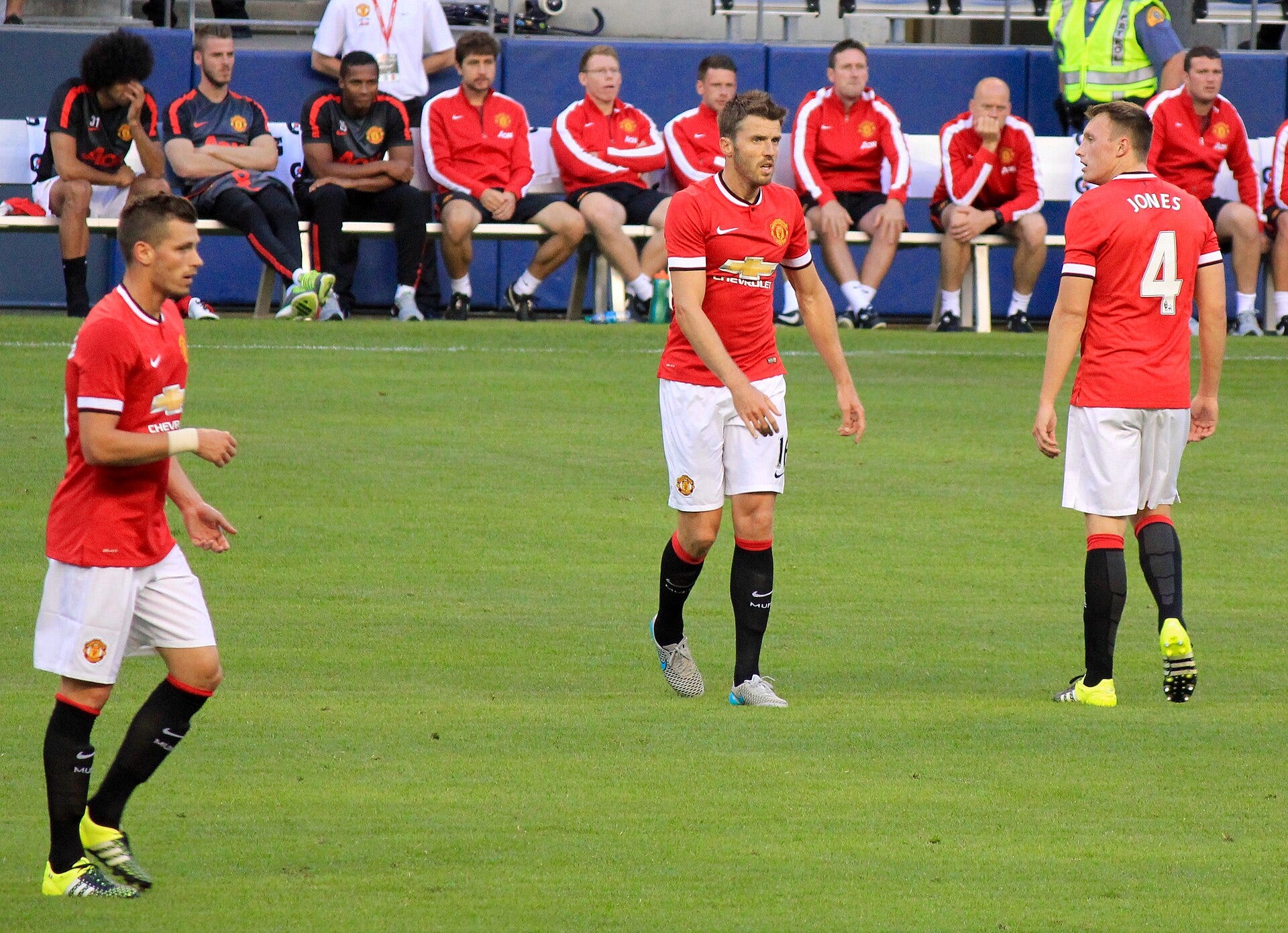
Michael Carrick playing for Manchester United during a preseason friendly against Club América in Seattle, July 2015. Photo: Matt Janzer / Wikimedia Commons, CC BY-SA 2.0.
Manchester United have looked slow.
Not always. There are still presses, recovery runs and stretches where the tempo rises. But there have also been long periods this season where United seem half a step behind whatever is happening around them.
Second balls disappear. Midfielders get dragged into space. Opponents play through the first pressure and suddenly there is a lot of grass between the people trying to stop them.
Then the running numbers started showing up.
United were near the bottom of the Premier League in several measures of high-intensity work. Distance covered became part of the conversation. Sprint numbers followed. After a few particularly flat performances, the explanation started writing itself.
Maybe they just weren’t being worked hard enough.
That was the part I wanted to test.
Carrick’s sessions had already been described as shorter. Once United started looking leggy, that detail stopped sounding incidental.
It started sounding like evidence.
At least at first.
I wanted to know whether the numbers actually took us there.
The numbers really are bad.
That part holds up.
Through the first five Premier League matches, United were 16th for total distance covered. More concerningly, separate GeniusIQ data had them bottom of the league for high-intensity distance, time spent at high intensity, total sprints and sprinting time.
That is the kind of data that makes the eye test feel vindicated.
United look passive, the numbers say they are producing very little high-intensity work, and suddenly the fitness explanation feels pretty obvious.
Except the categories are not interchangeable.
Total distance is not sprinting. Sprinting is not pressing. Pressing is not fitness. And none of them, on their own, tell us what is happening in training.
That was where the easy explanation started to wobble for me.
United are holding more of the ball than they did last season. They are defending higher. They are spending more time in a high block.
All of that changes what running is supposed to look like.
The concern is still legitimate.
The diagnosis is where things get harder.
The first problem with using running numbers as a verdict on fitness is that football decides what kind of running a team has to do.
United are averaging close to 60 percent possession in the Premier League this season. Under Carrick last year, that number was closer to 49 percent.
That matters.
Spend more time with the ball and there are fewer minutes available to chase it. Sit deeper and you may accumulate more defensive distance. Play higher and you may ask for fewer runs overall, but more explosive ones when the ball turns over.
Liverpool are probably the cleanest warning against reading mileage too literally. They have been among the lowest-distance teams in the league while producing one of its highest sprint totals.
Same sport. Very different physical profile.
United complicate it further.
Their out-of-possession sprint frequency has not collapsed. They are averaging roughly 89 of those sprints per 90 this season, compared with 86 under Carrick last year.
That was the number that stopped me from treating this as a simple effort problem.
United are still making explosive defensive actions.
The harder question is what those actions are actually accomplishing.
This is where the tactical picture starts to matter.
United are defending from a high block much more often than they did last season. Opta has them at 42 percent this year, up from 26 percent during Carrick’s spell last season.
On paper, that sounds aggressive.
The problem is that United are not consistently turning that higher starting position into sustained pressure. Their PPDA sits only a little better than league average, and their high-turnover numbers remain middling.
The fitness explanation was getting messier.
If the front line jumps and the first pressure is beaten, somebody has to deal with the space behind it. Opta’s analysis suggests United’s back four has not always held an equally aggressive height, which leaves more for the midfield pair to cover between the press and the defence.
That is where the tracking data gets uncomfortable.
United rank at the bottom of the league for tracking runs, and the midfield is being asked to defend more open space than it did last year.
From the outside, that can look exactly like a team that is not fit enough.
But spacing can create the same picture. Timing and role clarity matter too, especially if you are asking players to cover distances they are not particularly suited to cover.
Last season, Carrick managed this part of the game better. United were not suddenly full of elite runners then either, but the structure protected them more effectively in transition.
This season, the shape is more aggressive without the personnel becoming dramatically quicker.
The space still has to be covered by someone.
By this point, “they are not fit enough” was starting to feel less like an answer and more like one possibility among several.
So what does training actually tell us?
Less than people usually want it to.
Public reporting described Carrick’s sessions as shorter, while United’s own preseason material showed a mixture of running, gym work and football-specific training.
That matters, because the easy version of the criticism is that United simply have not been working hard enough.
The public evidence does not really let us say that.
It also does not let us say the opposite.
Football-specific drills can absolutely build conditioning, but they do not automatically reproduce the same high-speed and sprint exposure players face in matches. A tight-sided game can leave everyone exhausted without necessarily reproducing that same kind of high-speed work.
My U10 rec team has also occasionally finished training looking completely spent. I would not recommend using that as evidence of elite conditioning methodology.
The problem is that the part that would actually settle this is mostly hidden.
We do not have United’s GPS data. We do not know the weekly sprint-exposure targets, individual load plans or how much extra high-speed work gets added away from the clips the club releases.
If MUTV wants to add Carrington GPS data to next season’s subscription, I’ll reluctantly consider the upgrade.
Until then, we can see what training looks like.
We cannot see enough to know whether the physical dose is right.
The World Cup makes this harder too.
United were not the only Premier League club trying to build a preseason around players returning at different times, in different physical states, after different tournament runs.
Arsenal had the same problem. Liverpool did too. City arguably had an even bigger one.
And the physical profiles that followed were completely different.
Arsenal came out of a heavily disrupted summer and still ranked among the league’s highest-distance teams. Liverpool sat near the bottom for total distance but produced huge sprint numbers. City looked much closer to United across several early running metrics.
That gave me something useful to compare United against.
The World Cup clearly complicated preparation.
It did not make every team look the same.
So United’s fragmented preseason belongs in the explanation, but it cannot carry the whole thing.
What happened after those players came back clearly depended on more than when they returned.
By this point, the numbers had answered part of the question.
United’s high-intensity output really is poor. The high block is real. So are the tracking problems once that first pressure is broken.
What the numbers had not done was tell me whether any of that began in training.
Physical preparation is still one possibility, but so are tactical structure, execution and personnel.
The annoying part is that those things can overlap.
A midfielder can be asked to cover too much ground and still fail to make the run he should. A training program can be sensible in theory and still fall short of what the system demands on Saturday. A tactical plan can also make fit players look slow if the distances between them are wrong.
That was the distinction I kept coming back to.
The data can show us what United are struggling to produce.
It is much worse at telling us where the problem starts.
Watching United lately, it is easy to reach for the simplest explanation.
They look slow, so maybe they are not fit enough. They fail to sustain pressure, so maybe the sessions are not demanding enough.
The numbers do not get us all the way there.
What they show is a team struggling to produce the kind of high-intensity football its structure seems to demand. United are defending higher without consistently turning that position into pressure, and when opponents get through the first line, the tracking numbers are poor.
Training may be part of it. So might the distances Carrick is asking this midfield to cover.
The frustrating answer is that those things can overlap, and the public data is not capable of separating them for us.
I started this looking for a fitness problem.
What I found was a physical problem with more than one possible cause.
Research & References
This piece draws on Premier League and Opta tracking data, GeniusIQ physical-performance data reported by Reuters, Manchester United’s own preseason and training material, contemporary reporting on Michael Carrick’s training methods, and peer-reviewed sports-science research into football conditioning and high-speed running exposure.
Where possible, I have linked directly to the underlying data or original reporting in the body of the article. The physical metrics used here do not all come from the same provider or describe exactly the same type of movement. Total distance, sprint frequency, high-intensity running, pressing actions and tracking runs are therefore treated as separate measures rather than interchangeable definitions of effort or fitness.
The early-season comparisons also come with an important limitation. Most of the current United data used in this piece covers the first five Premier League matches, while comparisons with Carrick’s previous season are generally expressed as per-90 rates across his 17 league matches in charge. Those figures can help identify changes in United’s physical and tactical profile, but five matches are not enough to establish a settled season-long pattern.
The training question has an even larger limitation. Public reporting and club footage can tell us something about how United train, but they cannot provide the internal GPS data, individual loading plans, sprint-exposure targets or complete session design that would be needed to judge the physical program directly.
The sports-science research used here similarly describes general mechanisms rather than Manchester United specifically. Football-specific drills can contribute meaningfully to conditioning, while sided-game formats can produce less high-speed and sprint exposure than competitive matches depending on pitch size, player numbers and other constraints. That does not establish what Carrick’s players are or are not doing behind closed doors at Carrington.
The World Cup comparisons are also treated as context rather than controlled experiments. Arsenal, Liverpool, Manchester City and Manchester United had different numbers of players involved, different tournament workloads, different return dates and different tactical demands once the Premier League season began.
Those limitations matter.
This article does not treat low running numbers as proof of poor fitness, poor fitness as proof of inadequate training, or tactical structure as an alternative that automatically clears physical preparation. The evidence is used to test how much Manchester United’s public match data can actually tell us about where the problem begins.
Sources consulted include official material from the Premier League and Manchester United; data and analysis from Opta and GeniusIQ; reporting from Reuters and the BBC; and peer-reviewed research published in sports-science and football-performance journals.
What do you think?
When a team looks physically flat, what do you trust more: what you see, the running numbers, or the tactical context around them?
Do United look underprepared physically to you, or are the numbers reflecting the way Carrick is asking them to play?
And if the answer is somewhere between the two, where would you start looking first?