

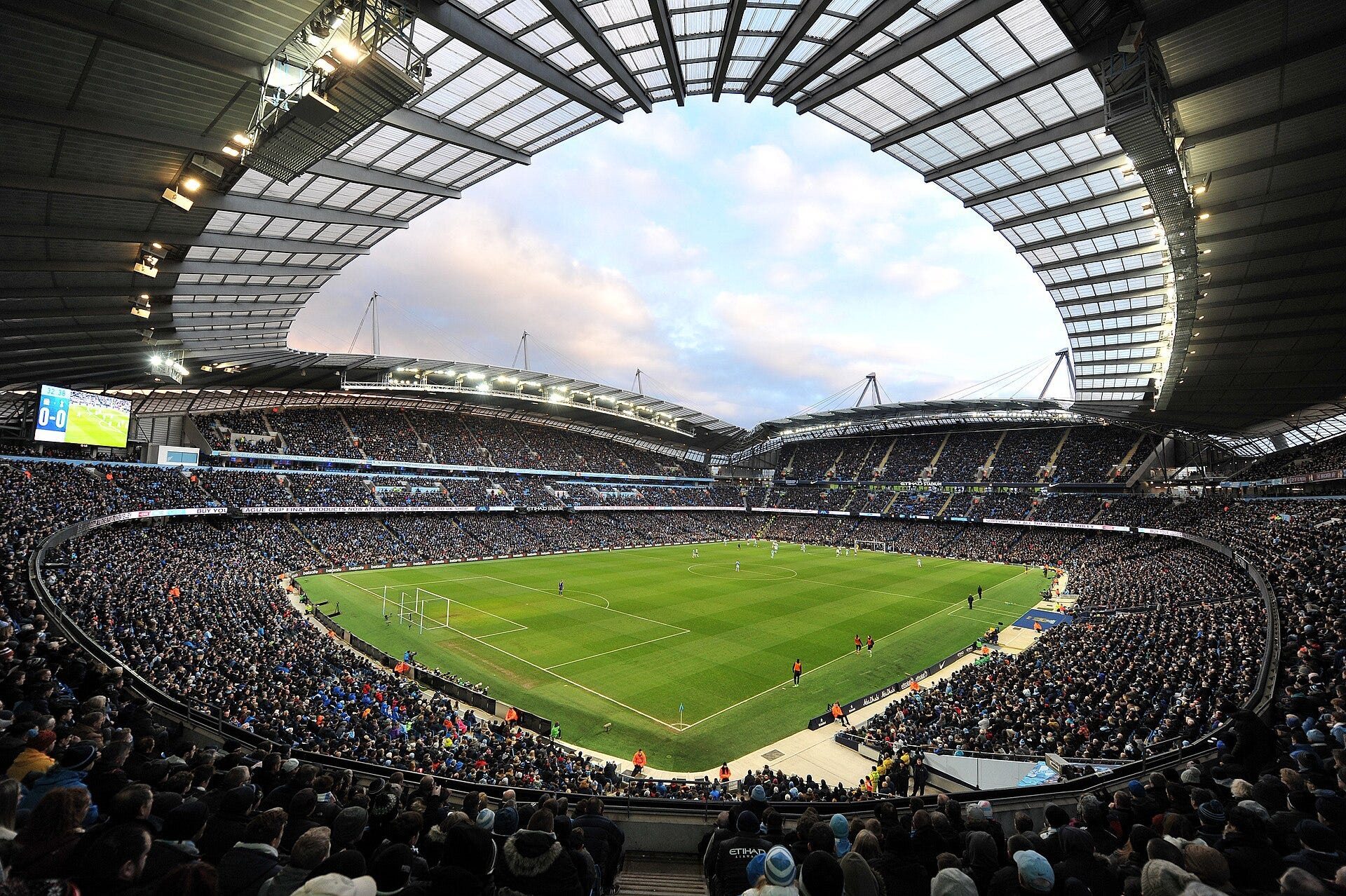
Etihad Stadium, Manchester. Photo: Cléria De Souza / Wikimedia Commons, CC BY 2.0.
Manchester City sent me looking at Financial Fair Play.
Which isn’t exactly surprising right now.
But somewhere in reading about the case, I got stuck on something much simpler.
Fair.
We’ve been arguing about Financial Fair Play for more than fifteen years. Clubs have been investigated, fined, restricted and excluded from competitions under rules carrying some version of that name. Supporters have learned entirely too much about allowable losses, amortisation, related-party transactions and accounting periods.
And I’m not sure we agree on what the fair part is supposed to mean.
I certainly didn’t.
My assumption going into this was that I more or less understood the arrangement. Football clubs were spending too much money, UEFA wanted them to become financially sustainable, and Financial Fair Play was just the name they gave the solution.
The further I went back, the less comfortable I became with that explanation.
Because fair wasn’t added later.
It was there at the beginning.
In August 2009, before the regulations themselves had been approved, UEFA’s Professional Football Strategy Council backed a set of financial-control measures whose stated aims included improving “financial fairness in European competitions” and the “long-term stability of club football across Europe.”
Those are two different ideas.
And football had a very real problem with the second one.
In 2009, top-division European clubs generated about €11.7 billion in revenue. Revenue had increased 4.8 percent from the year before.
Costs increased 9.3 percent.
The clubs collectively lost nearly €1.2 billion.
Employee costs had climbed to 64 percent of revenue.
Two years later, those aggregate losses had reached roughly €1.7 billion.
That number is almost difficult to reconcile with what was happening everywhere else. Football wasn’t a dying industry. Revenues were growing. Television money was growing. Commercial income was growing.
The sport was getting richer.
It was also getting worse at keeping the money.
Portsmouth showed what could happen when the money underneath all of that stopped working.
The club entered administration in February 2010, only months after UEFA had first publicly backed the principles that would become Financial Fair Play. The administrator’s report eventually put Portsmouth’s liabilities at more than £100 million. Draft accounts showed staff costs equivalent to 109 percent of revenue.
One hundred and nine percent.
Just on staff.
And Portsmouth hadn’t only borrowed against what it already had. Some future transfer instalments owed to the club had been brought forward through financing arrangements, turning money due later into cash available sooner.
I recognized that immediately.
I’d spent an entire previous investigation trying to understand why football clubs pull future income into the present. There is nothing inherently reckless about doing it. Receivables financing can simply solve a timing problem.
But Portsmouth had much bigger problems: enormous wage costs, substantial liabilities and a football club that eventually couldn’t pay everyone it owed.
And everyone matters here.
Football clubs were owed money.
So were tax authorities.
So were ordinary businesses.
Once the club went into administration, the consequences weren’t confined to the owner who had taken the risk or the players whose contracts had helped create the wage bill. They reached creditors who had never agreed to gamble on whether Portsmouth could stay competitive in the Premier League.
That changed the question for me a little.
From where we sit now, supporters often experience financial regulation through what their club can’t do. A player can’t be signed. Another has to be sold. And somehow following a football club now occasionally requires a working knowledge of amortisation.
Go back to 2009 and 2010, though, and something else is visible.
UEFA wasn’t inventing a financial problem to justify regulating football clubs.
There was one.
None of that tells me whether Financial Fair Play is actually fair.
But it killed the easiest version of the argument I had brought with me.
Before I could figure out whether the solution was fair, I needed to understand exactly what it was supposed to protect.
The answer, at least on paper, was fairly straightforward.
UEFA wanted clubs to pay their bills.
That sounds almost insultingly simple considering what Financial Fair Play eventually became, but creditor protection was there from the beginning. The original regulations talked about clubs settling what they owed to other clubs, employees and tax authorities. They talked about financial discipline, responsible spending and protecting the long-term viability of European football.
They also said something that would become much more complicated.
Clubs should operate on the basis of their own revenues.
At first, that made sense to me too.
If a football club earns £100 million every year but regularly spends £150 million, something has to fill the gap. Maybe it’s debt. Maybe it’s an owner. Maybe it’s money borrowed against income the club hasn’t received yet.
Whatever it is, the football operation isn’t paying for all of itself.
And there were plenty of reasons for UEFA to care about that.
Málaga is probably the cleanest example.
In 2012, UEFA found that Málaga had more than €14 million in overdue payables. By the end of September, more than €8 million was still overdue.
There was an argument over some of that money. Málaga maintained that certain tax obligations had been deferred. UEFA disagreed because the required written agreements weren’t in place by the reporting deadline. The dispute eventually reached the Court of Arbitration for Sport.
CAS sided with UEFA.
Málaga was fined €300,000 and excluded from the next UEFA competition for which it qualified within the applicable period.
There are much sexier parts of Financial Fair Play to argue about.
This isn’t one of them.
Pay your bills.
And Málaga wasn’t alone. In September 2012, UEFA withheld competition prize money from 23 clubs while it investigated significant overdue payments.
By the following reporting deadline, no overdue-payables balances remained at sixteen of those clubs, and UEFA closed their cases.
That’s worth sitting with for a second.
Because when Financial Fair Play is discussed now, the conversation tends to revolve around spending limits. How much can a club lose? How much can an owner invest? How much can be spent on players?
But one of the earliest versions of enforcement was considerably less philosophical.
You owe someone money.
Pay them.
And on that measure, something changed.
In June 2011, clubs monitored by UEFA reported €57 million in overdue payables.
By June 2019, that number was €2 million.
It didn’t fall neatly every single year. And those numbers alone don’t prove that Financial Fair Play caused the entire decline.
But €57 million to €2 million is difficult to dismiss.
The broader financial picture moved too.
In 2011, European top-division clubs had collectively lost roughly €1.7 billion.
By 2017, they recorded an aggregate bottom-line profit of €615 million—the first overall profit in UEFA’s records.
Again, I want to be careful here.
UEFA credits Financial Fair Play with helping produce that turnaround. UEFA is also the organization that created Financial Fair Play.
European football changed enormously over the same period. Revenues grew. Broadcasting deals grew. Domestic rules changed. Clubs became more commercially sophisticated. There isn’t an honest way to look at two numbers six years apart and assign the difference to one regulation.
European clubs, in aggregate, were making more money without immediately losing all of it.
Overdue bills had collapsed.
And for the first time in UEFA’s records, European top-flight clubs were profitable in aggregate.
If Financial Fair Play was supposed to improve the financial health of European football, it is difficult to look at that record and argue that nothing improved.
But there was another problem.
Football clubs don’t spend money in isolation.
If one club receives another £30 million and decides to save it, that’s financially responsible.
If the club it is competing against takes the same £30 million and buys a striker, responsibility might also make the first club worse at football.
That tension existed well before FFP. As revenues grew in the years leading up to the rules, wages were growing faster. Between 2007 and 2012, UEFA calculated that club revenues increased 42 percent. Wage growth reached 59 percent once currency fluctuations were removed.
More money was entering football.
A remarkable amount of it was finding its way back out through the competition for players.
Michel Platini later said something about the creation of Financial Fair Play that caught me.
Some owners, he said, had asked UEFA to intervene because they felt they were being “obliged to invest in order to be competitive.”
That’s different from UEFA protecting clubs from irresponsible owners.
Some of the owners wanted protecting from each other.
The logic isn’t particularly difficult to understand.
One owner spends.
The team improves.
Its rivals now have a sporting reason to spend too.
Nobody has to be reckless. Nobody even has to be behaving irrationally.
The problem is that what makes sense for one club can become expensive when everyone does it.
And suddenly “operate on the basis of your own revenues” starts doing more than protecting creditors.
It puts a limit on how far that competition can go.
That helped me understand why parts of the industry supported the idea. In 2009, the proposal had the backing of UEFA’s Club Competitions Committee, the board of the European Club Association and the Professional Football Strategy Council.
This wasn’t simply UEFA imposing financial discipline on an industry begging to be left alone.
At least some of the industry wanted the restraint.
And by this point, I was having a harder time with the version of Financial Fair Play I had carried into the investigation.
The financial problem was real.
The unpaid bills were real.
The spending pressure was real.
And the financial results that followed were, at minimum, substantially better.
I could understand why football wanted rules.
What I still didn’t understand was why the amount a club should be allowed to spend had to depend so heavily on the amount that club could already earn.
Because those aren’t quite the same question.
This is where I started getting stuck on the money.
Because “operate on the basis of your own revenues” sounds straightforward until you start asking what counts as your own.
Chelsea is a useful place to start.
Roman Abramovich bought the club in 2003 and immediately gave Chelsea access to money the football club could not have generated on anything close to the same scale itself.
But Chelsea wasn’t some tiny club suddenly created by a billionaire. In the season before Abramovich arrived, it generated about £93 million in football revenue and ranked tenth in Deloitte’s Football Money League.
A year later, that revenue was roughly £144 million.
Some of that increase came from something fairly obvious.
Chelsea got considerably better at football.
Its run to the Champions League semifinal in 2003/04 generated an estimated €44 million from the competition alone. More success meant more prize money, more television money and eventually more commercial opportunity.
It would be too easy to draw a straight line through those numbers.
Abramovich spent money. Chelsea won. Chelsea made more money.
There is truth somewhere in that sequence, but the numbers don’t tell us how much of Chelsea’s additional revenue was directly caused by owner investment. They certainly don’t tell us what would have happened without it.
What they do show is something more interesting for this question.
Money that begins outside a football club can help create conditions in which the club eventually generates considerably more money of its own.
And once it does, those revenues are treated differently.
That matters because the obvious defense of Financial Fair Play is Portsmouth.
What happens when the person funding everything leaves?
Chelsea gives us an uncomfortable counterexample.
Abramovich announced his intention to sell Chelsea on March 2, 2022. On March 10, he was sanctioned by the UK government, placing severe restrictions on the club’s operations and turning the sale into an extraordinary government-regulated process.
Whatever Chelsea’s dependence on Abramovich had meant before then, access to him had changed abruptly.
Chelsea didn’t disappear.
The club was eventually sold in a transaction involving £2.5 billion for the shares, alongside a commitment from the new ownership to invest another £1.75 billion.
That doesn’t prove Chelsea’s model was sustainable.
A £2.5 billion purchase price isn’t recurring football revenue. It doesn’t tell us what Chelsea would have become without Abramovich’s investment, and one extraordinarily valuable club can’t establish that owner financing is generally safe.
But it does make Portsmouth harder to use as the entire answer.
Outside money can create dependence.
It can also help build something that remains extraordinarily valuable after the person supplying that money is gone.
Then I got to Newcastle.
And the question became harder again.
Saudi Arabia’s Public Investment Fund led the consortium that bought Newcastle United in October 2021. Whatever else can be said about the takeover, access to capital was not the problem.
Newcastle’s ability to spend it on football was.
The club reported £180 million in revenue for the year ending June 2022, although the new ownership had only been in place for nine months of that period. It also recorded a £70.7 million after-tax loss, with the club pointing in part to investment in the squad during the January transfer window.
Then the revenue started moving.
By 2022/23, Newcastle’s revenue had reached £250.3 million.
In 2023/24, it reached £320.3 million.
Commercial revenue increased 90 percent that year. Matchday revenue increased 32 percent. Newcastle had also returned to the Champions League.
The owners continued putting capital into the club.
But that capital and Newcastle’s ability to spend on its first team are not the same thing.
Financial regulation doesn’t simply say that wealthy owners can’t invest in football clubs. Money can go into facilities, infrastructure and other parts of the business, and the rules can actually encourage equity investment rather than additional debt.
What they constrain is the extent to which an owner’s wealth can become immediate sporting spending.
Newcastle can become richer.
It just can’t become as rich as its owner overnight.
And there is a logic to that.
If Portsmouth taught football anything, it was that the existence of someone willing to cover losses today doesn’t guarantee that person will still be willing, or able, to cover them tomorrow.
But Newcastle also exposes the other side of the decision.
Imagine two clubs.
One has spent decades building a huge supporter base, commercial operation and global brand. It can generate hundreds of millions of pounds every year.
The other has a much smaller revenue base but an owner willing to invest hundreds of millions of pounds into it.
Both owners might have the money.
Both clubs might be perfectly capable of paying their bills.
But financial regulation does not treat their spending capacity as equivalent.
The first club can spend more because the club already earns more.
The second has to grow into that ability.
Which brings us back to Manchester City.
The current Premier League case is now on appeal. An independent commission found City guilty of serious financial-rule breaches across nine seasons, including the use of sham commercial arrangements that artificially inflated revenues and reduced costs. City has appealed those findings.
For this investigation, though, the important part isn’t whether I can relitigate the case.
I can’t.
It’s what the dispute reveals about the system.
Once football decides that spending should be connected to the money a club generates, somebody has to decide what counts as genuinely generated revenue.
That is why related-party sponsorship matters.
It isn’t enough that money arrived in a club’s bank account. Regulators may have to ask where it came from, whether the transaction was genuinely commercial and, in some circumstances, whether its stated value reflects fair value.
UEFA had already confronted that problem with Paris Saint-Germain years earlier. In its 2014 settlement with PSG, UEFA examined the club’s agreement with the Qatar Tourism Authority and assigned it a fair value significantly below the value PSG had submitted.
The money existed.
The question was how much of it should count.
And suddenly I was a long way from unpaid bills.
Financial Fair Play wasn’t only putting a ceiling on spending.
It was drawing a line between different kinds of money.
And I had arrived at a question I hadn’t been asking when I started:
When does an owner’s money become a football club’s money?
I make teams for a living.
Not football teams worth billions of pounds, obviously. Teams of twelve-year-olds in PE.
And in a gym full of twelve-year-olds, fair is remarkably easy to understand.
I know who the strongest athletes are. I know which kids can dominate a game. If I put too many of them on one team, I move somebody.
The goal isn’t complicated. Make the teams competitive enough that both sides have a reasonable chance.
If one team destroys the other, I probably didn’t make very fair teams.
Financial Fair Play doesn’t work like that.
And I think that’s where the word had been tripping me up.
Because if a club is supposed to grow primarily from the money it already generates, then the clubs that already generate the most money retain an obvious advantage.
That isn’t a loophole in Financial Fair Play.
It’s how the system works.
A club with decades of domestic success, a massive supporter base, valuable commercial relationships and regular Champions League income can turn those advantages into greater spending capacity. If that spending produces more success, the cycle can continue.
Success produces revenue.
Revenue permits spending.
Spending can help produce more success.
That doesn’t mean the cycle is automatic. Plenty of rich clubs spend badly. Plenty of smaller clubs outperform richer ones. Football remains wonderfully resistant to behaving exactly as a spreadsheet says it should.
But the advantage is real.
And researchers were asking versions of this question almost as soon as Financial Fair Play arrived.
Some argued that requiring clubs to move toward break-even could suppress spending while strengthening the position of the traditional elite. If established clubs already had the largest revenue bases, restricting the ability of challengers to cover losses with outside investment could make it harder to close the gap.
The uncomfortable part is that some of what happened afterward looks consistent with that concern.
But this is where I had to slow down again.
Because “competitive balance” sounds like one thing.
It isn’t.
A league can be measured by how close its teams finish on points. By how predictable individual matches are. By how concentrated championships have become. By how often different clubs reach the top four.
Those measures can tell different stories.
So can different leagues.
One study comparing six seasons before and after the introduction of Financial Fair Play found a significant deterioration in competitive balance in Spain, Germany and France, but not a statistically significant deterioration in England or Italy.
Another focused on the Premier League and found no evidence that FFP had worsened competitive balance there, with some measures suggesting it may even have improved.
Broader research has found increasing concentration in some European leagues and fewer different clubs reaching the top four or winning championships in many of them. Other long-run research has found the overall effect of FFP on domestic competitive balance to be much smaller.
So I couldn’t get a clean answer from the research either.
There is evidence that parts of European football became more concentrated during the FFP era.
There isn’t clean evidence that FFP caused it.
European football wasn’t standing still while UEFA changed its financial rules.
Champions League money was becoming increasingly important. Broadcasting revenue was distributed differently across domestic leagues. Commercial income was concentrating around globally successful clubs. The biggest teams were becoming international businesses in a way smaller clubs simply weren’t.
UEFA itself eventually acknowledged the problem, warning about what it called “globalisation-fuelled revenue polarisation.”
And there is a particularly awkward piece of evidence here.
So some of the revenue giving Europe’s biggest clubs greater regulatory spending capacity was coming from UEFA’s own competition.
That makes it very difficult to look at increasing concentration, notice that Financial Fair Play existed at the same time, and stop there.
There are too many other things moving.
UEFA seems to have understood that too. It later discussed measures aimed more directly at competitive balance, including squad limits, luxury taxes, transfer-market reforms and greater redistribution.
That’s a pretty good defense.
If the existing hierarchy is unfair, allowing every club to spend whatever its owner is willing to lose doesn’t remove inequality.
It changes where the inequality comes from.
And this was the point where my original question became genuinely annoying.
Suppose a billionaire buys a smaller club.
The owner spends heavily, recruits better players and breaks into a group of clubs that had dominated the league for years.
Has competitive balance become worse?
Maybe.
There is now another extremely wealthy team capable of concentrating talent and winning repeatedly.
But has mobility improved?
Also maybe.
A club that previously had little realistic path into the established elite has suddenly moved into it.
Those aren’t necessarily the same thing.
Manchester City is an obvious reason this distinction matters. Whatever conclusion is eventually reached in its current legal process, City’s rise also disrupted an existing hierarchy in English football.
A system can become more financially concentrated while becoming easier for one particular challenger to penetrate.
Which leaves the alternative.
What if football simply allowed owners to spend whatever they wanted?
That sounds fair in one sense. Every club is allowed to do exactly the same thing.
But permission isn’t the same as capacity.
Every club could be allowed to have an owner willing to spend £500 million.
Every club won’t have one.
We would have replaced an advantage based partly on historic success, supporter size and club-generated revenue with an advantage based much more heavily on the wealth and willingness of whoever owns the club.
Maybe that’s preferable.
But it isn’t neutral.
And this is where my gym version of fair starts to break down.
If I make bad teams in PE, I can stop the game and move a kid from one side to the other.
Nobody has a five-year contract.
Nobody owes another school a transfer payment.
Nobody has borrowed against next year’s dodgeball revenue.
And no local business is going unpaid because one of my teams really wanted to win seventh-grade basketball.
A football club isn’t just one side of a game. It’s an institution that employs people, signs contracts, borrows money and can fail.
So maybe simply making the teams more equal isn’t enough either.
Neither are the alternatives.
An absolute spending cap would attack the advantage of enormous existing revenues much more directly, but it would also represent a fundamentally different way of deciding how much clubs can spend.
A luxury tax could allow clubs to spend above a threshold while making that spending progressively more expensive and potentially redistributing some of the proceeds.
Greater revenue sharing could attack the inequality before clubs ever reach the spending rules.
The Premier League even considered a system known as Top-to-Bottom Anchoring, which would have linked spending at the top more directly to income received by clubs at the bottom.
It didn’t receive enough support.
Instead, beginning in 2026/27, the Premier League moved to a Squad Cost Ratio system. Its basic structure still ties squad-cost limits to football-related revenue and player-trading results.
UEFA’s current rules do something similar. Its squad-cost rule limits specified first-team costs to 70 percent of a calculation built principally from adjusted club revenue and player-trading results.
Different percentages.
Different details.
The same uncomfortable question underneath them.
Why should money generated by yesterday’s success be treated differently from money an owner wants to spend trying to create tomorrow’s?
There are answers.
Portsmouth is part of one.
Málaga is part of another.
The financial turnaround of European football matters too.
But by this point, I didn’t think Financial Fair Play could really be understood as a system designed to make football financially equal.
It isn’t.
Football still allows enormous financial advantages.
History can create one.
Supporter size can create one.
Champions League qualification can create one.
Commercial power can create one.
An owner can create one too, but the rules place different limits on how that advantage can be converted into spending on the pitch.
I started this trying to figure out what Financial Fair Play was actually protecting.
I think I was expecting a cleaner answer.
The clubs, obviously.
Their creditors.
Maybe the competition itself.
And depending on which part of the rules you’re looking at, all of those answers can be true.
What I wasn’t expecting was how quickly the word fair would become the harder part.
Because financially healthy and competitively equal are not the same thing.
A system can make it harder for clubs to accumulate unpaid bills without making it easier for a smaller club to catch a larger one. It can protect employees and creditors while also making existing revenue more valuable. It can stop an owner from immediately converting enormous personal wealth into an enormous playing budget without making the financial advantages already held by established clubs disappear.
Those things can all exist at once.
Which is probably why the gym kept coming back to me.
Nobody is asking me to keep Team Blue solvent.
I’m not checking whether Team Red can make payroll next month. There aren’t creditors waiting outside the gym. Nobody’s future depends on whether one particularly enthusiastic parent gets bored and stops funding the team.
Football has to care about those things.
And once it does, fair becomes harder to define.
The rules UEFA created don’t give every club the same amount of money. They’re built around the idea that clubs should increasingly support their football operations with money the clubs themselves produce.
There is a defensible reason for that.
A club’s obligations don’t disappear when an owner’s willingness to fund them does.
Player contracts still exist.
Employees still need paying.
Transfer instalments still come due.
So do taxes and invoices.
Portsmouth helps explain why that matters.
So does Málaga.
And the improvement in European club finances after the rules arrived makes it difficult to dismiss financial sustainability as nothing more than an excuse for regulation.
But there is a cost to choosing club-generated revenue as the foundation.
Yesterday matters.
The supporters accumulated over decades matter. The commercial relationships built during successful eras matter. Champions League appearances matter. The revenue produced by all of it matters.
Past success doesn’t guarantee future success.
It does, however, help determine how much you’re allowed to spend pursuing it.
And that’s where I ended up seeing Manchester City differently too.
Not as the answer to whether Financial Fair Play works. And not as a shortcut to deciding whether the system is fair.
City’s appeal still matters. The Commission’s findings are findings under appeal, and whatever ultimately survives that process deserves to be treated accordingly.
But the dispute exposes something underneath the regulations that exists regardless of how the appeal ends.
Football has to decide which money counts.
It already has.
Money earned through broadcasting counts.
Commercial revenue counts, subject to rules about how some transactions are valued.
Competition income counts.
Player trading can increase spending capacity.
Owner investment can build parts of a club, but it cannot simply be converted without limit into first-team spending.
Those aren’t laws of nature.
They’re choices about what kind of financial advantage football is prepared to recognize.
I don’t think that makes Financial Fair Play a lie.
I also don’t think it makes the word fair meaningless.
It just means I was asking too much of it.
I was thinking about fair the way I would in a gym: look at the teams, look at what each one has, and try to give both a reasonable chance to win.
Financial Fair Play is trying to solve a different problem.
It asks clubs to compete without making their survival depend entirely on someone continually paying the difference.
That can make football healthier.
It can also leave yesterday’s winners with advantages tomorrow’s challengers don’t have.
And I’m not sure there is a rule that makes both of those problems disappear.
Remove the limits and wealth doesn’t disappear. It moves toward the owners capable of spending the most.
Keep revenue-linked limits and wealth doesn’t disappear either. It remains concentrated around the clubs already capable of generating the most.
Put in a hard cap, redistribute more revenue or tax spending above a certain level, and football would simply be making a different decision about where advantage is allowed to come from.
Maybe that’s what I had been missing in the name all along.
Financial Fair Play doesn’t tell us what fair football looks like.
It tells us which financial advantages football has decided to allow.
Research & References
This piece draws on UEFA and Premier League regulations and financial reports, club accounts and announcements, Court of Arbitration for Sport decisions, contemporary reporting, and academic research into Financial Fair Play and competitive balance.
Where possible, I have relied on primary sources for regulatory language, financial figures, disciplinary decisions and club disclosures. Academic claims are linked to the underlying studies rather than summaries of their findings.
The financial figures used throughout the piece do not always describe identical populations or accounting measures. UEFA’s aggregate profitability figures refer to European top-division clubs, while overdue-payables figures come from clubs monitored through UEFA’s financial-control system. Where those populations differ, I have treated them separately rather than as directly interchangeable.
The competitive-balance research is similarly mixed. Different studies examine different leagues, periods and measures of competitiveness, and the evidence does not establish a clean causal relationship between Financial Fair Play and the concentration of sporting success. The article reflects that uncertainty rather than treating correlation during the FFP era as proof of causation.
Manchester City’s current Premier League case requires particular care. An independent commission has issued findings concerning financial-rule breaches, and Manchester City has appealed those findings. The findings are therefore described as findings under appeal rather than as the final resolution of the case.
Sources consulted include official material from UEFA, the Premier League, Chelsea and Newcastle United; decisions and materials from the Court of Arbitration for Sport and the UK government; Deloitte’s Football Money League; contemporary reporting from The Guardian and other established outlets; and academic research published in Economic Policy, Sport, Business and Management, Sustainability and other peer-reviewed publications.
Regulations, financial information and the status of Manchester City’s appeal are current as of October 6, 2026.
What do you think?
What should “fair” mean in football?
If one club can spend more because decades of success have given it a larger revenue base, while another has an owner willing to invest the same money today, should the rules treat those advantages differently?
And if they should, where would you draw the line?
I’m curious which version of fair makes the most sense to you.